
Showroom vs Trade Show Booth: Which Drives More Orders?
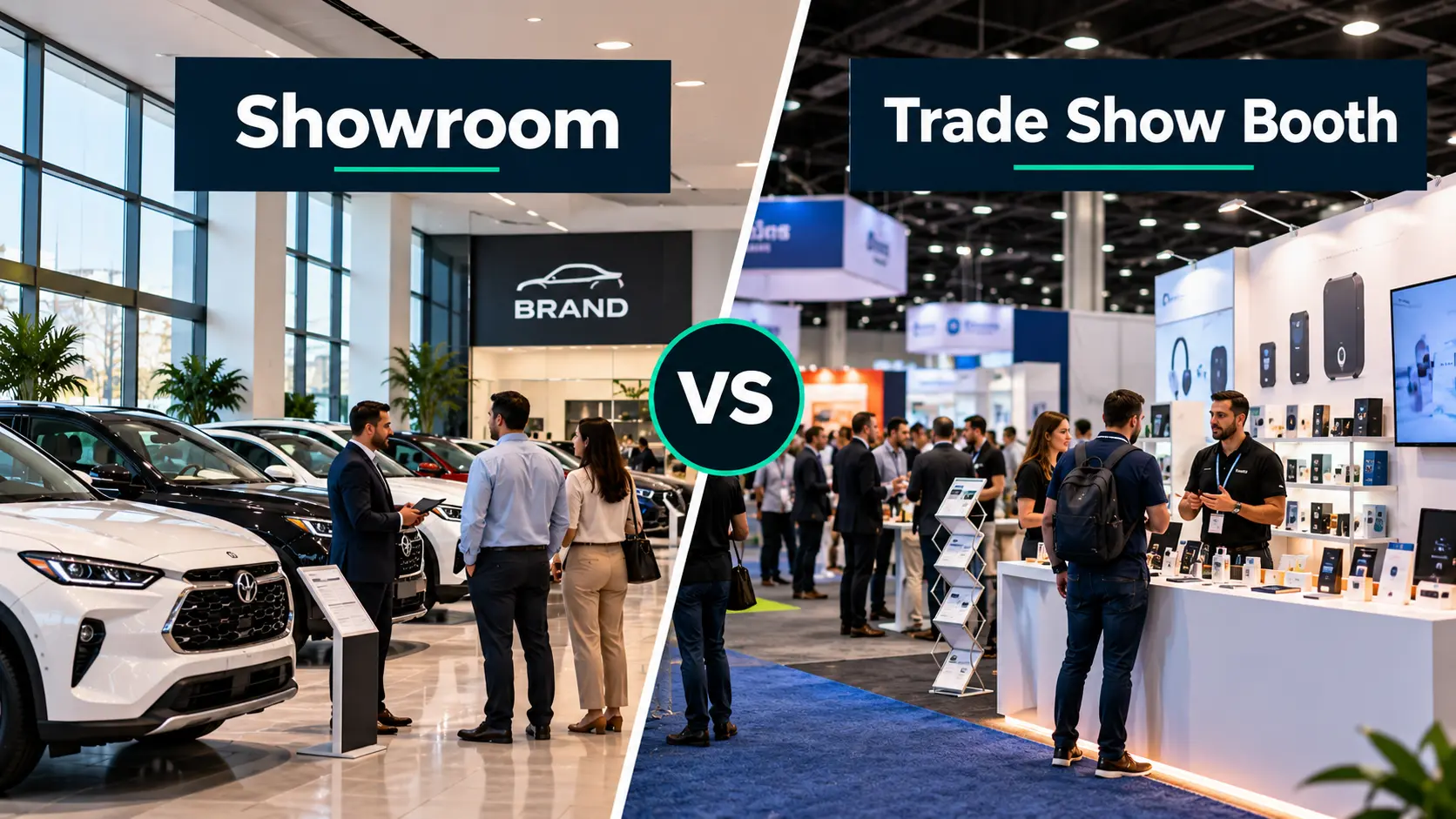
Brands ask us the same thing every January and every July: showroom vs trade show booth, which one actually writes orders? Wholesale here means selling your line at a trade price to retailers who resell it, rather than direct to a shopper. We rent showroom floors at 545 8th Avenue and watch what happens in them during New York Market Week, the days each season when buyers come to town to order. We also hear from brands arriving after a booth season with a spreadsheet they wish they had built earlier.
The answer is not “it depends.” It changes by brand stage, and below is the recommendation plus what reverses it.
The real difference between a fashion showroom and a trade show booth
A trade show booth puts your line in a hall where thousands of buyers walk past. A fashion showroom puts it behind a door that only invited people come through. One is discovery at scale with no control. The other is control with no discovery.
At a show the organiser owns the buyer list, the floor plan, the hours, the contractor who moves your freight and the neighbour whose rail touches yours. In a room on 8th Avenue you own the hours, the lighting and the calendar, and the whole job of filling it.
In womenswear and accessories the shows you will hear named are COTERIE, the contemporary and advanced contemporary women’s show, and MAGIC New York at the trend and young contemporary end. Fashion by Informa runs both at the Jacob K. Javits Convention Center, and COTERIE lists its next New York edition on February 7 to 9, 2027, with MAGIC Las Vegas, PROJECT, SOURCING and OFFPRICE sharing one Las Vegas Convention Center floor. For home, gift and lifestyle lines the equivalent is NY NOW, also at Javits.
Those dates are the seasonal buying calendar in practice, and a buyer’s open-to-buy, the budget a retailer has left for a category in a delivery window, is usually set before they land.
What a trade show booth costs once everything is counted
The exhibitor fee, the charge for the floor space itself, is the smallest part of the bill. The Center for Exhibition Industry Research put exhibit space at 37.9% of the average exhibiting budget in its 2017 study of where the exhibiting dollar goes, with show services at 12.8%, exhibit design at 11.4%, travel at 10.9% and shipping at 8.9%. CEIR surveys every industry, not fashion alone, and that is an average from a past year, so check its current edition.
Read it the plain way. Whatever the space quote says, it is roughly a third of what you will spend.
Published rates are hard to find because most shows quote privately. One exception: the Greeting Card Association listed Noted 2026 booth rates at Javits alongside NY NOW for its February 2026 edition at $2,300 for a 5 by 5, $4,000 for a 5 by 10 and $6,000 for a 5 by 15, plus $300 for a corner. Those are for association members in that section, so treat them as one data point. The package covers 8 foot white walls, a parcan light, a chair, carpet and a booth sign.
A 10×10 trade show booth, the standard 100 square foot inline footprint with neighbours either side and an open front, is the next size up and where most first-time apparel brands start.
The line items nobody puts in the first quote
Drayage catches people hardest. It is material handling: the charge for moving your crates from the dock or advance warehouse to your booth and back out, billed by weight by the show’s general contractor rather than your shipper. NY NOW’s exhibitor manual names Freeman as general service contractor and the exclusive provider of material handling.
NY NOW’s Winter 2026 deadlines sheet names Freeman for furnishings and flooring, puts the Freeman discount deadline about four weeks before opening, and opens the advance warehouse about twelve days out, after which late material costs more. None of those add-ons is large on its own. There are dozens, each with its own deadline.
The same manual requires every exhibitor to carry general liability cover of $1,000,000 per occurrence and $2,000,000 aggregate, and prices material handling separately from the booth package for anything loose, uncrated or small parcel.
Then the booth build. A trade show booth rental means hiring walls, lighting and fixtures from the contractor for the week, cheaper upfront and interchangeable with everyone else’s. A custom trade show booth is fabricated for you and has to be stored and shipped between seasons. Trade show booth design is where brands overspend hardest in season one, because a beautiful 10 by 10 in a hall of four hundred booths is still a 10 by 10.
What a showroom week actually costs
A showroom week is close to a single line item. You book a room by the hour against a minimum, bring rails and samples, and pay for the hours.
Our rooms run on a ten hour minimum, and the published starting rates show the shape of the decision. 16A starts at $65 an hour, so $650 for a ten hour day and $3,250 across a five day market week. 14AB starts at $180, so $1,800 a day and $9,000 for the same five days. The full set of rooms we let as fashion showrooms sits between. These are “from” rates that move with date and availability, so price your actual week.
What is not in that number: travel, samples, printing, coffee for buyers who arrive at nine, and whoever fills the calendar. A showroom rep, an agent who carries several brands and books buyers into a room, takes commission on what they write, a percentage of order value, not a flat fee.
Showroom vs trade show booth, side by side
| Trade show booth | Rented fashion showroom | |
| Main cost components | Exhibitor fee, booth build or rental, drayage, show services, electrical, insurance, labour, travel | Hourly rate against a minimum, rails, travel, samples, rep commission if used |
| Setup time | Organiser’s move-in days, freight deadlines weeks ahead | Hours, inside your booked block |
| Buyer volume | High, unqualified, driven by floor traffic | Low, qualified, driven by your list |
| Appointment control | Little. Buyers arrive when they arrive | Complete. You set the slots |
| Follow-up quality | Scanned badges, many with no order intent | Named buyers who sat with the line |
| Best fit | No buyer list yet, or a broad line needing floor space | Twenty or more named buyers and a tight edit |
One worked cost model, where every input is a placeholder
Replace every figure below with one from your own quote. These are not research findings. They are empty slots.
| Input | Placeholder | Replace it with |
| Booth space | $4,000 | Your show’s quote |
| Space as a share of total | 37.9% | CEIR’s all-industry average, not fashion |
| Implied all-in booth cost | about $10,500 | Your quote divided by your own share |
| Booth appointments booked ahead | 8 | Your outreach results |
| Booth walk-ups that order | 4 | Last season, if you tracked it |
| Showroom week, five days, entry rate | $3,250 | The published rate for your dates |
| Showroom appointments confirmed | 18 | Your invite list and reply rate |
| Showroom appointments that order | 7 | Your close rate |
| Average first order value | $3,500 | Your line sheet and minimum order quantity |
On those placeholders the booth produces 12 orders at roughly $875 each in acquisition cost and the showroom 7 at roughly $464. Drop the showroom’s confirmed appointments from 18 to 6 and the room becomes the dearer option. That sensitivity is the real finding. The model is not driven by rent. It is driven by how many buyers answer your email.
Cost per order, not headline price
Two metrics settle the argument. Cost per order is total spend divided by orders written. Cost per qualified appointment is total spend divided by buyers who sat with the line and could order, excluding the student, the competitor and the buyer with no open-to-buy left in your category.
Run both. A booth with forty scans and six orders has an acceptable-looking cost per order and a cost per qualified appointment that says the scans were worthless.
Then read sell-in against sell-through. Sell-in is what the retailer bought from you. Sell-through is what their customer bought from them. A season of cheap sell-in to accounts that never reorder costs more than a smaller season of accounts that do, and nothing on a show floor tells you which you are shaking hands with.
Appointments you can actually run in a day
The arithmetic is unglamorous. A ten hour showroom day at 45 minute buyer appointments with 15 minutes to reset the rails gives ten slots, and you lose one or two to no-shows and one to lunch. Call it eight or nine with the buyer’s full attention.
A booth day has no slots. Buyers arrive in clumps around 10am and after lunch, three at once then nobody for forty minutes. You may speak to thirty people and get fifteen real minutes from four.
How buyers behave in a booth versus behind a door
In a booth the buyer is standing, carrying a tote, comparing you against the brand two rails over while you talk. The line gets eighty seconds. No custom trade show booth fixes a line that needs touching.
In a private room the buyer sits. They go through the line by delivery, ask what your minimum order quantity is, ask about net terms, the days after invoice they have to pay, and say things they never say on a floor. Buyers discuss budget in a room and dodge it in a booth.
What happens after the handshake
A booth leaves you a badge list. A showroom leaves you a diary.
The follow-up differs in kind. After a show you are qualifying strangers and a share of the scans never reply. After a showroom week you chase people who held your fabric.
The order still has to land somewhere. JOOR and NuORDER are the digital wholesale platforms most contemporary buyers already have logins for, and both let a buyer order against your line sheet, the trade document listing styles, colours, wholesale and retail prices, minimums and delivery windows. Faire sits further down market with a long tail of independents. A lookbook, the styled image document a buyer forwards internally to sell your brand to their own team, does a job the line sheet cannot.
Have all three ready before either format. Shooting a line sheet in a studio is the part brands leave to the last week.
Where a trade show beats a showroom, honestly
We rent showrooms. We would still send some brands to a booth first.
A show sells discovery, and discovery is the one thing a private room cannot manufacture. If your buyer list has four names on it, a showroom week is an expensive empty room. A booth puts you in front of buyers who have never heard of you, including international buyers and small independents who fly in for one show a year and never book an uptown appointment.
A show also gives you category adjacency: being sited near brands a buyer already stocks is an endorsement no private room sells. Press walks the floor.
And in some categories the show is the calendar. Home and gift buyers plan their year around NY NOW. If your buyers treat one show as the season, missing it costs more than exhibiting does.
There is a third option neither column covers. A shared or group showroom puts several brands in one room on one appointment list for market week, which is how a good many Garment District floors run. It halves the room cost and borrows the other brands’ buyers. You give up sightlines and some control of the schedule in return.
Our recommendation by brand stage
Season one, no buyer list. Take the booth. Take the smallest real footprint the show will sell you, rent the walls instead of building them, and judge the season on names collected, not orders written. You are buying a list.
Seasons two and three, twenty or more named buyers. Take the showroom week. The list you built at the show is the asset, and a room converts it at a fraction of the cost per qualified appointment. Several brands run a booth one season and a Garment District room the next, keeping discovery alive without paying for it twice a year.
Established, with repeat accounts. The showroom, and the only question is which room. Price the whole range first: the gap between an entry room and the largest is roughly $5,750 across five days.
What flips the recommendation
- A broad line across several categories, which needs floor space more than privacy.
- A buyer base that is mostly international and only travels for shows.
- A category where one show is the whole seasonal buying calendar.
- A thin travel budget, since Las Vegas costs flights and a Midtown room does not if you are already here.
- A line that depends on hand feel, which argues for a room even in season one.
Doing both in one season, and in what order
You can, and the order matters. Book the showroom for the days immediately before or during the show, never after it.
Buyers in town for COTERIE or MAGIC New York are here for a block of days and will take a nearby appointment inside that window. They will not come back two weeks later. If your room is open before the floor opens, you get them while their open-to-buy is intact and their feet are not yet sore.
The Garment District advantage during New York Market Week
This is the practical reason brands book a wholesale showroom here instead of, or alongside, a booth.
We sit at 545 8th Avenue in the Garment District, the Midtown blocks at the centre of the American apparel trade for a century. The Javits Center’s main entrance is at 429 11th Avenue, three avenues west of us at roughly the same cross street. Javits publishes its own travel guidance: the 34th Street/Penn Station stop is served by the A, C and E under 8th Avenue and the 1, 2 and 3 under 7th, and the M34 runs crosstown to the building.
A buyer leaving the show floor is a short crosstown ride or a walk from your room, and the trains that carry them home run under our building. MAGIC New York’s exhibitor page puts the February 2027 edition on Level 3 at Javits on February 7 to 9, and COTERIE runs the same three days. A room three avenues away, open on those dates, catches buyers in the gap between floor appointments.
Short bookings are what most brands want. 23B is listed as temporary showroom space from $80 an hour and 23A as a pop-up showroom from $105, both on the ten hour minimum, so a three day block runs roughly $2,400 and $3,150. Brands running a selling event alongside appointments sometimes take the wider pop-up inventory instead, and 16AB sits mid-range at $140 for a broader line.
A temporary room changes the maths because the minimum changes. Three days at the entry rate is under $2,000, less than drayage and electrical on many small booths.
Where a virtual or digital fashion showroom fits
A virtual fashion showroom or digital fashion showroom, meaning a hosted 3D or video presentation rather than a room, works well as the thing you send after a meeting and badly as the thing you send instead of one. Buyers use it to re-check a style, share the line internally and reorder without a call.
It has not replaced the first appointment where hand feel decides the order. It has replaced the second one.
What to have ready, and how far ahead you commit
Before either format: a finished line sheet with wholesale and retail prices, minimums and delivery windows; a lookbook; net terms decided; your JOOR or NuORDER catalogue live; enough samples in the right size; and either a packed calendar or a reason to expect floor traffic.
Timelines differ sharply. Show commitments run months ahead and the deadlines are the hard part, not the decision. NY NOW’s Winter 2026 deadlines sheet put the Freeman discount deadline four weeks before opening and Javits electrical orders two weeks out. Refundability sits in the exhibit space contract and tightens as the show nears, so read that clause before you sign.
A room is shorter and softer. Most of ours book online with instant availability and the cancellation window is published against the listing. Freight access, ceiling height and the things people forget before signing for a showroom are worth walking in person.
FAQs
Is a trade show booth or a fashion showroom cheaper for a first season?
A showroom week is cheaper in cash: five ten hour days in an entry level room here start around $3,250, while a booth’s space quote is only about 37.9% of the eventual bill on CEIR’s average. The booth can still be the better season-one spend, because it buys the buyer list.
How much does a 10×10 trade show booth cost?
No single figure is honest, since shows quote privately and rates vary by hall. The one published rate card we can point to is the Greeting Card Association’s Noted 2026 pricing at Javits: $4,000 for a 5 by 10 plus a $300 corner, for members in that section. Get your quote, then divide by your own space share.
How many buyer appointments can you run in a day in a fashion showroom?
Eight or nine in a ten hour day, at 45 minute appointments with 15 minutes between to reset the rails, allowing for a no-show or two. A booth day gives you more conversations and far fewer minutes per buyer, since arrivals clump around mid-morning and after lunch.
Can you rent a fashion showroom in NYC for just one day?
Yes. Our rooms run on a ten hour minimum, so one market-week day at the entry rate is around $650 and a three day block in a temporary room around $2,400, often less than the drayage and electrical bills alone on a small booth.
What is drayage, and why does it surprise first-time exhibitors?
Drayage is material handling: the show contractor’s charge for moving freight from the dock or advance warehouse to your booth and back, billed by weight rather than by your shipper. It catches people out because it is quoted separately from shipping and from space, charged both directions, and rises if crates miss the warehouse window.
Where does a virtual fashion showroom fit alongside a physical one?
As the follow-up, not the substitute. A digital fashion showroom is where a buyer re-checks a style, forwards the line internally and reorders without a call. For a first order where hand feel decides the sale, buyers still want the room.