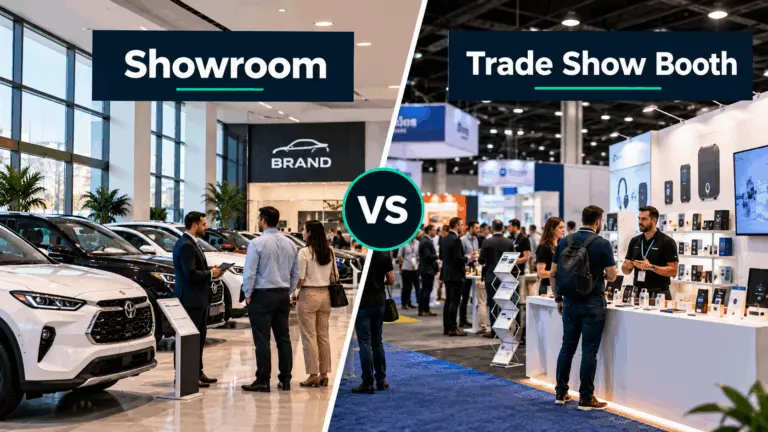
Multi-Brand vs Single-Brand Showroom: Where a Fashion Line Sells in New York

The multi-brand vs single-brand showroom question in fashion wholesale rarely arrives calmly. It arrives six weeks out from market, when a founder counts four names on the appointment calendar, three of them friends. We run showroom floors at 545 8th Ave in the Garment District, and in one February week we will have a multi-line agency working eleven labels off two rails and a single brand two floors up with its own room and its own buyer list.
Both models work. They fail for different reasons, and the failure modes are the useful part.
What a multi-brand showroom is, and what a single-brand showroom is
A multi-brand showroom, also called a multi-line showroom, is a sales business representing several unrelated brands at once out of one space with one team. The company operating it is a sales agency. The person who builds the appointment book, sits with the buyer, writes the order and chases the reorder is the showroom rep, sometimes titled showroom sales consultant. You are one line on their rail. A New York house can carry a dozen or more labels, and luxury fashion showroom operations tend to cap themselves lower, because a rep can only carry so many stories into one appointment.
A single-brand showroom is the opposite arrangement.
One brand controls the space, staffs it with its own people and shows nothing but its own collection. Year-round lease, seasonal lease across two or three market cycles, or a room booked for the days of market and handed back.
Multi-brand vs single-brand showroom, compared
| Multi-brand showroom | Your own single-brand room | |
| Control | Low. Rail position and appointment order are the rep’s call | Total. Layout, lighting, who walks in |
| Cost structure | Commission on what sells, often a retainer on top | Rent, fit-out and staff bill whether you sell or not |
| Buyer reach | Borrowed. A working buyer list on day one | Yours only. Nobody walks in by accident |
| Speed to market | Fastest. Appointments exist before you sign | Slowest. A list takes two to four seasons |
| Brand presentation | Shared sightlines, a neighbour’s print in every photo | Uncompromised. The room is the brand |
| Risk | Rep turnover, roster conflict, agency-owned accounts, exclusivity signed unread | Fixed overhead. An empty room still bills |
How a brand actually gets into a multi-brand showroom
You get in by being easy to sell and plausible to reorder. Reps are estimating how many dollars your line adds per hour of appointment time: your price point against their roster, whether your delivery dates have slipped, whether a buyer who bought you once bought you again.
What they ask for:
- A line sheet. Style number, fabrication, colourways, wholesale cost, suggested retail, delivery window, minimum order quantity per style and per order.
- A lookbook. On-figure, current season, not stitched from three shoots at three colour temperatures.
- Door count and the names. Fourteen doors with six reorders beats sixty with none.
- Lead time and your cut-off for a confirmed purchase order.
Cold outreach converts badly. A buyer telling a rep they want to buy you converts well. Reps also scout at market, which is why brands exhibit at COTERIE New York, next in New York on February 7 to 9, 2027 (COTERIE), with no expectation of covering the booth. They are buying rep attention and buyer names. Expect to be asked for a category exclusive, and how your open-to-buy conversations went.
What showroom reps charge, and how the deals are structured
Four structures cover most of what gets signed here. Commission on net shipped and paid wholesale, kindest to cash flow. Commission on booked orders, better for the agency, because you owe on orders that later cancel. Retainer plus commission, a fee against the rep’s time at a reduced rate. Or a flat seasonal or rack fee plus pass-through costs, commission on top.
There is no published, apparel-specific, audited commission standard for New York showrooms, and anyone quoting one as the industry rate is quoting a habit. The closest real dataset comes from the Manufacturers’ Agents National Association, the trade body for independent sales agencies. Its published guidance gives suggested ranges from a survey of 402 MANA members by customer type: end-user sales at a high of 14%, an average of 11% and a low of 7%, distributor sales at 9%, 7% and 5%, and OEM at 7%, 6% and 5%. MANA states plainly that these “get you into the ballpark”, that rates may run above them, and that the right number depends on the product, the customer type, the business already sitting in the territory and the extra services the principal wants (Manufacturers’ Agents National Association).
Two caveats. MANA’s membership is industrial and consumer-goods agencies rather than fashion showrooms, and the association notes its own survey participation fell away after the mid-2000s. Treat the figures as evidence about how these deals are shaped, not a price for your category.
So ask the rep in writing for the rate, the exact base it sits on, the rate on a house account the agency already held, and every fee beyond commission. Then put the answers in the contract. Where a principal contracts with a sales representative to solicit wholesale orders in New York, Labor Law section 191-b requires the contract to be in writing, to set out the method by which commission is computed and paid, and to be handed to the rep as a signed copy (New York State Senate). That statute protects the rep, not you, which is the point: a showroom proposing a handshake is proposing you both skip a requirement. Check the current text, since labour law gets amended.
What running your own single-brand showroom costs
Nobody can hand you this number, because the two largest inputs are your rent and your payroll. Every row below is your figure to fill in, and the only one you can look up is the room.
| Line item | Your number |
| Room | Hourly rate times hours times market days, or annual rent divided by seasons |
| Fit-out | Rails, mirror, steamer, seating, signage, lighting, amortised over seasons kept |
| Samples | Yardage plus make cost per style, times styles, times size sets |
| Staffing | Your wholesale hire’s loaded cost for the selling weeks, plus market-day temps |
| Market overhead | Catering, printing, couriers to the factory, a second steamer |
| Digital | Platform subscription plus hours to build the digital line sheet |
| Opportunity cost | Founder hours spent selling instead of designing |
Divide the total by new doors opened. That is your cost per door, the only figure that makes the two models comparable.
One anchor so the room row is not guesswork. Bookings here carry a 10 hour minimum at $65 to $180 an hour, so 22C comes to $650 for the minimum and 23AB, the double room brands take when showing apparel and accessories together, comes to $5,400 for three market days. Both sit under one month of a year-round lease.
Which model gets a new brand in front of more buyers faster
The multi-brand showroom, and not by a small margin. A rep with an established book opens their calendar and twenty buyers who already trust their judgement take an appointment. Your line gets eight minutes inside somebody else’s 45.
Where it gets oversold is conversion. Borrowed attention converts worse, because the buyer came for the rep’s other line and sees yours on the way out. A brand that writes six small opening orders in its first season has not failed. It bought a buyer list at the cost of one season’s margin.
Your own room in a first season sells only to the people you emailed. A founder books a room on 16, props the door open, and spends three days beside a rail nobody came to see. The missing reason to get in the lift is the problem, not the room.
What you give up in a multi-brand showroom
Control of the story, first. Your collection gets merchandised into the agency’s floor plan, grouped with whatever the rep thinks it sits near. Nobody pitches your atelier’s history. They pitch your $148 shirt against a $120 one two rails over.
You give up the buyer relationship, functionally, because the contact lives in the agency’s system and the note that one store never takes black lives in a rep’s head. Feedback fidelity goes too: why a buyer passed, which fabric felt wrong in the hand, the two who wanted a shorter length, all compressed into “they loved it, price was tough.” Then margin, and your sell-in calendar.
The quiet one: you lose the ability to tell whether your line is selling or your rep is. You find out when the rep leaves.
How brand adjacency helps or hurts you
Brand adjacency is the effect of what hangs beside you. Buyers read a rail the way they read a shelf, and they assume the showroom did the sorting. Next to two labels a step above you on price and finish, you benefit at no cost. Next to a label that discounts hard in October, a buyer who sees you both waits for your markdown too.
Ask for the roster before signing, then ask three things. Where you sit on price in that lineup. Which labels compete directly with you. Which account is the agency’s largest, because that line takes the first fifteen minutes of every appointment and the best wall.
In your own room nothing props you up and nothing drags you down. A brand with real brand equity, buyers who ask for it by name, gains from isolation. A brand nobody has heard of loses, because adjacency was doing the vouching.
How exclusivity and territory clauses work
An exclusive territory grants the agency sole right to represent you in a defined area, commonly the United States. Commission then applies to orders from that territory whether or not the agency generated them. Sell to a Los Angeles boutique by direct message inside an exclusive US territory and you usually owe commission on it.
House accounts are carved out of commission, because you held them before signing or the agency did. Name them in a schedule attached to the contract. A house account defined by a sentence instead of a list is a future argument.
Then the tail. A post-termination commission clause lets the agency keep earning on reorders from accounts it opened after you leave. A season or two is defensible. No end date is not.
What happens to your buyer relationships if you leave a showroom
You keep orders already written and whatever you built yourself. You do not keep the relationship automatically, and you tend to lose any account where loyalty sat with the rep rather than the clothes. Brands find on leaving that a share of their best doors were the rep’s doors, not theirs.
Three things before you give notice. Get the account list with contacts in a usable file, and check your contract entitles you to it. Reconcile commissions owed, including on orders shipping after you go. Write to every stockist yourself, with a named person and a direct email, before the agency does.
Labor Law section 191-c requires earned commissions to be paid within five business days of termination, or of becoming due where they were not yet due, and a principal who fails is liable in a civil action for double damages plus reasonable attorney’s fees and costs (New York State Senate). That one protects the rep against you, which is the reason to settle cleanly rather than slowly.
The middle path most Garment District brands actually take
Book a dedicated room for market week only. Show your own line, under your own name, for three to five days, then hand the keys back.
Three days in a 16AB room in the Garment District costs a four-figure sum and keeps full control of presentation, with no commission, no exclusivity, no roster and no lease. Broader lines take the double 14AB room, or hold a temporary showroom booking for the market days and nothing else. Between markets some return for a trunk show in a pop-up room on 23.
The honest limit, because this model gets sold dishonestly: a market-week room does nothing for a brand with no buyer list. The room generates no appointments. Buyers in town for market walk between addresses they chose weeks earlier.
So the test is one question. Can you name twenty buyers, at twenty specific stores, who would take a meeting if you emailed them next Tuesday? Store names, not categories. If no, you are paying for a quiet empty room, and the multi-brand showroom is not a compromise, it is the right answer for where you are.
The light at 2pm, the second mirror and the breaker that trips under a steamer are the things to check before committing to a room. The showroom rooms across the four floors publish rates and minimums, as do rooms let as pop-up space.
How digital showrooms change the comparison
They change the sell-in, not the sell. A virtual fashion showroom, a hosted digital line sheet with live inventory, order writing and reorder, removes the reason a buyer in Dallas needs to stand in a room with you in September. JOOR describes itself as a wholesale platform with more than 14,000 brands across 53 categories and more than 700,000 retail buyers (JOOR), and NuORDER by Lightspeed describes a virtual showroom and catalogue product used by over 7,000 brands and 500,000 retailers (NuORDER by Lightspeed). Both are vendor figures, so read them as scale claims rather than audited counts. Those platforms also carry multi-brand digital showrooms, so an agency can show your line to a buyer in another city without a rail.
The effect is narrower than the marketing suggests. A digital fashion showroom raises the floor for a single-brand operation, because a small team can manage orders without a rep’s back office, and it lowers the value of the admin function commission used to buy. It does not touch the rep’s judgement or their phone. It turns the room into a persuasion space: buyers feel the fabric, then write the order on a laptop that evening. A digital line sheet needs the same image discipline as a printed one, which is why a catalogue workflow that keeps flats and on-figure consistent matters more now, not less.
When a brand graduates to its own space
| Signal | Stay multi-brand | Go single-brand |
| Doors | Under about 30, mostly first orders | Repeat accounts, not new doors, drive the season |
| Who buyers ask for | The rep, by name | Your brand, by name, before they book |
| Line breadth | One category, narrow SKU count | Several categories, or a line that needs a room to read |
| Category | Core basics, price-led, bought off a spreadsheet | Luxury or designer, bought on feel and story |
| Commission burden | Cheaper than a wholesale hire plus rent | Exceeds a wholesale lead plus room cost |
| Appointments | The agency fills your calendar | You fill your own calendar |
| Conflict | Roster is complementary | A direct competitor joined above you on price |
If buyers ask for you by name, adjacency has stopped paying you. If annual commission has passed the cost of your own wholesale lead plus market-week rooms, you are renting a sales function you could own. Do not jump straight to a lease: take market-week rooms first and see whether your calendar fills two seasons running.
How to measure which model is working
Four numbers, held season over season.
- Cost per door. Total selling cost divided by new doors opened. Compare models on this, not on commission rate.
- Sell-through at your top ten accounts. Units sold at full price over units shipped. A model that opens doors which never sell through loses money behind a healthy order book.
- Reorder rate. Share of accounts buying a second season. The clearest read on whether the clothes worked or the pitch did.
- Appointment source. Who created each meeting, you or the agency.
What to get in the showroom agreement before you sign
Beyond the rate, the base and the territory terms above, make sure these are written down.
- Payment timing in days, and when commission reverses on a cancelled order.
- Every fee that is not commission, named and capped.
- Channel carve-outs: your e-commerce, your own retail, off-price, international distributors.
- Notice period and renewal mechanics, in calendar dates.
- Account list ownership and your right to a copy on exit.
- Minimum performance in appointments or dollars, and the remedy if the agency misses it.
- Who the named rep is, and what happens if that person leaves.
MANA publishes a manual on rep-principal agreements with sample clauses, worth reading because it argues the rep’s side. And do not skip the last bullet. You are signing a company and buying a person.
FAQs
What is the difference between a multi-brand showroom and a single-brand showroom?
A multi-brand or multi-line showroom is a sales agency representing several unrelated brands from one space with one team, paid by commission and often a fee. A single-brand showroom shows only your collection, staffed by your own people, with cost in rent and payroll. One buys reach, the other buys control.
How much commission do fashion showrooms take?
No published apparel-specific standard exists, so any figure quoted as the industry rate is a habit rather than a source. The Manufacturers’ Agents National Association, a trade body for independent sales agencies, publishes suggested ranges from a survey of 402 MANA members, with end-user sales averaging 11% and reaching 14%. Ask your rep for the rate and the exact base it sits on.
Do I need a written contract with a showroom in New York?
Yes. New York Labor Law section 191-b requires a contract between a principal and a sales representative soliciting wholesale orders in the state to be in writing, to set out how commission is computed and paid, and to be given to the rep as a signed copy. Check the current text on the New York State Senate site.
What is a market-week-only showroom and who is it for?
A room booked for the three to five days of New York Market Week, shown under your own name, then handed back. It suits a brand that already has a buyer list, because it carries no commission, no exclusivity and no lease. It does nothing for a brand without a list, since the room generates no appointments.
Do digital showrooms replace a physical showroom?
No. A digital fashion showroom handles line sheets, order writing and reorders, which removes the administrative reason to meet. Buyers still want to handle fabric and read a collection hung together before committing an open-to-buy budget. The room has shifted toward persuasion, with the order written online later.
When should a brand open its own showroom?
When buyers ask for the brand by name before they book, when reorders rather than new doors drive the season, and when annual commission has passed the cost of a salaried wholesale lead plus seasonal room rental. Until all three are true, a multi-brand showroom is cheaper.