Casting Rental Space in New York: Options by Size & Budget
Finding the right casting rental space in New York can be difficult when you have to balance the number of attendees, room size, type of audition, equipment needs, location, and rental cost. A small private audition does not need the same setup as a large model casting, while a screen test may require better control over lighting, sound, and camera placement than a simple callback. The right choice comes down to matching the space to the way your casting will actually run. In this guide, we explain how to choose a casting space in NYC based on size and budget, which facilities matter, which costs can affect the final booking price, and what to check before reserving a studio.
What Makes a Good Casting Space in New York?
A casting space needs to support the complete flow of a session, from the moment talent arrives to the final audition. That means thinking beyond the room where the audition takes place. You may need somewhere for people to check in, sit while waiting, change clothes, prepare, speak with the casting team, or move between different stages of the process. For professional auditions, a space that looks good in photos may still be a poor choice if it creates noise, crowding, poor visibility, or delays between candidates.
A suitable casting rental space should give the casting team enough control to keep the session organized. The room should have enough usable floor area for the intended activity, suitable lighting, reliable internet and power, comfortable conditions, and a layout that works for the number of people involved. Actors’ Equity Association’s audition facilities provide a useful professional reference: its New York audition studios include dedicated waiting rooms, sound attenuation, heating and air conditioning, Wi-Fi, charging or power access, dressing rooms, and space for casting personnel. These features show why the practical setup around an audition can be just as important as the audition room itself.
A Suitable Audition Area
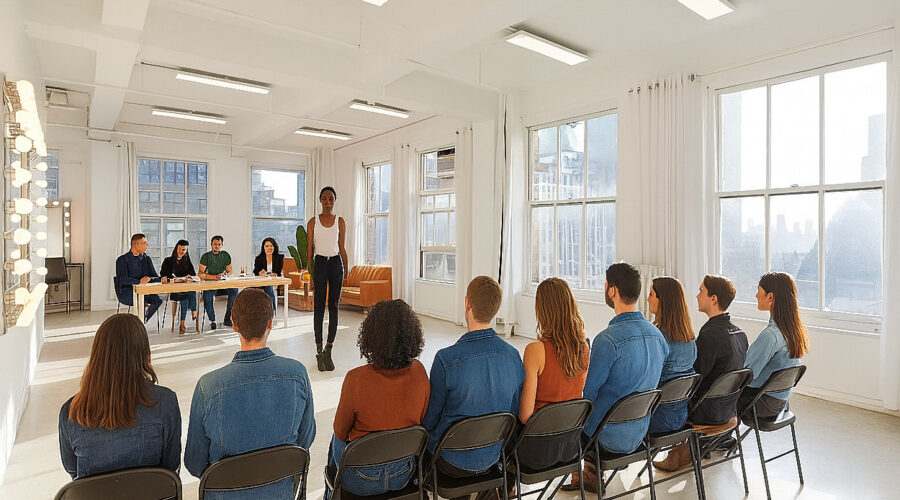
The audition area needs to accommodate the performer and the people evaluating them without making the room feel cramped. For an actor reading a script, this may mean space for the performer, reader, casting director, camera, and client representatives. A model casting may require more open floor area because the talent may need to walk, turn, pose, or be photographed from different angles. The required space also changes if auditions are recorded. A camera operator needs enough distance to frame the talent correctly, while lighting equipment, stands, monitors, and cables need to be positioned safely. A room that works for a seated interview may therefore be unsuitable for a full-body model casting or a screen test.
A Comfortable Waiting Area
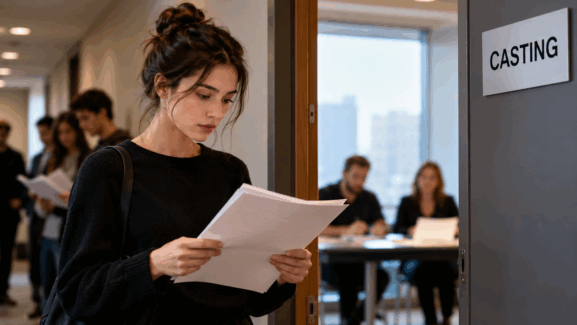
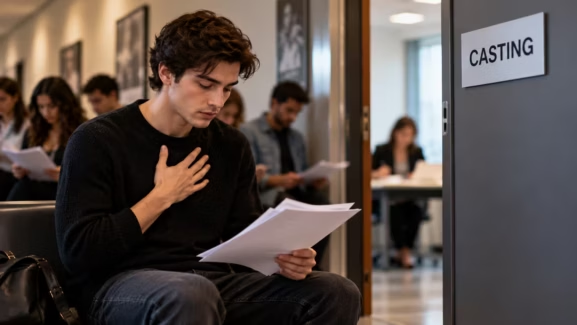
Waiting space becomes especially important when several people arrive for the same casting period. Without a proper holding area, talent can end up standing in hallways or crowding near the audition room, which can create noise and slow down the process. The best setup separates waiting from the actual audition area as much as possible. This lets the casting team call people in one at a time while keeping the room quieter for those being evaluated. It also gives talent a more professional place to wait between check-in and their audition.
Privacy, Sound and Controlled Conditions
Privacy matters for auditions where performers are reading confidential material, discussing roles, or completing callbacks. Sound also matters if the session involves dialogue, recorded auditions, interviews, or screen tests. A casting space should therefore be checked for outside noise, neighboring activities, door traffic, and the amount of control the venue gives you over the room. Climate control is another practical consideration, especially during long sessions with several people moving in and out. These details may seem small during a venue search, but they can have a direct effect on how smoothly a casting day runs.
How Much Casting Space Do You Need?
There is no single room size that works for every casting session. The right amount of space depends on the number of talent expected, the casting team, the client group, equipment, waiting arrangements, and what performers need to do during the audition. A one-on-one callback and a 50-person model casting have very different space requirements. It is better to calculate space around the actual workflow than to choose a room based on square footage alone. A larger room may provide useful breathing space for a busy casting call, but paying for capacity you will not use can increase the booking cost without improving the session.
Small Spaces for Private Auditions and Callbacks
A smaller casting room can work well for one-on-one auditions, callbacks, interviews, self-tapes, and private talent meetings. If the session involves one performer at a time and only a few people from the casting team are present, a compact space may give you everything you need. The main question is whether the room leaves enough space for the activity. If you need a camera, lighting, a reader, client seating, and room for the performer to move, a very small room can quickly become restrictive. Before booking, consider the equipment footprint and the number of people who will actually be inside the room at the same time.
Medium Spaces for Regular Casting Sessions
A medium-sized studio is often a practical choice for model castings, commercial auditions, actor auditions, callbacks, and sessions involving a small production team. It gives the casting team more room to arrange cameras and lighting while allowing talent to move comfortably.
This size can also make sense when the casting involves a steady flow of people rather than a single private appointment. You have more flexibility to create separate areas for the audition, waiting, check-in, and equipment without renting a very large production space.
Large Spaces for High-Volume Casting Calls
Large casting spaces become useful when many candidates are expected or when several people need to work inside the room at the same time. Open calls, larger model castings, agency sessions, and production-related auditions can require more floor area for talent movement and a larger working zone for casting staff.
A larger room should still be chosen for a specific reason. If most of the floor will remain unused, the extra cost may be difficult to justify. If the casting involves high traffic, several team members, multiple cameras, clothing changes, or significant movement, the additional space can make the session much easier to manage.
How to Estimate the Space Before Booking
Start with the expected headcount, then add the people who will be working behind the casting process. Consider the casting director, assistants, readers, client representatives, photographer or camera operator, and any production staff.
Then account for the equipment and activities involved. A useful planning formula is:
Talent + casting team + client team + equipment + waiting space + movement requirements = practical space requirement
This is more useful than choosing a room based on a generic capacity number because two casting sessions with the same headcount may need very different layouts.
Casting Space Rental Costs in New York
Casting rental prices in New York vary significantly by venue, location, size, rental duration, equipment, and booking terms. Current marketplace data illustrates that range. Peerspace reports an average of about $45 per hour for casting spaces in New York, while its current listings include spaces at substantially different rates depending on the venue and requirements. Its data also shows that most casting-space bookings run for around three hours, although individual venues can have different minimums.
That figure should be treated as marketplace data rather than a universal NYC rate. A professional casting studio with specialized equipment, a central Manhattan location, or additional production facilities can cost more than a basic room.
What Determines the Rental Price?
Several factors can change the final cost of a casting space:
- Room size: Larger studios generally provide more usable floor area and may support larger teams.
- Location: A centrally located Manhattan studio can have different pricing from a space farther from major transit areas.
- Rental duration: Minimum booking periods affect the total amount you pay.
- Equipment: Cameras, lights, modifiers, monitors, and other production equipment may be included or charged separately.
- Attendance: Some venues have different terms for larger groups.
- Additional services: Backdrops, cleaning, furniture, storage, setup, or technical assistance can add to the final cost.
- Time and date: Rates and availability can vary depending on the booking period.
Hourly Rate vs. Total Casting-Day Cost
The advertised hourly rate is only one part of the budget. A better comparison is the total amount required to complete the casting.
For example:
Base studio rental + additional hours + equipment + production add-ons + applicable fees = total booking cost
Setup and breakdown time should also be included in your planning. If the casting takes four hours but you need an hour to arrange equipment before talent arrives, you should check whether that preparation time must be included in the reservation.
This is why the lowest hourly price is not always the lowest overall cost. A slightly more expensive studio with the right equipment and layout may cost less than a cheaper room that requires multiple add-ons.
Which Casting Space Fits Your Budget?
Your budget should follow the needs of the casting rather than the other way around. Start by deciding how many people will attend, how much floor space the audition requires, and whether you need professional lighting or recording equipment. Then compare venues that meet those requirements.
Lower budgetSmaller casting roomPrivate auditions, interviews, small callbacksMid-rangeMedium studioModel castings, actor auditions, commercial sessionsHigher budgetLarge studioOpen calls, larger teams, high-volume castingProduction-focusedEquipped studioScreen tests, recorded auditions, camera-heavy sessions
| Budget approach | Suitable option | Best suited to |
If cost is a major concern, avoid paying for space you will not use. At the same time, do not choose a room that is so small that the casting team has to move equipment every time a new performer enters.
Which Type of Studio Is Right for Your Casting?
The best venue type depends on what performers actually need to do during the session. A casting director running short interviews may have different requirements from a fashion team evaluating models or a production company recording screen tests.
Dedicated Casting or Audition Studio
A dedicated casting or audition space is a strong option when auditions are the main purpose of the booking. These spaces can provide a more suitable environment for talent evaluation, with layouts that accommodate performers, casting staff, and waiting arrangements. This can be especially useful for callbacks, interviews, model go-sees, and auditions where privacy and an organized flow matter.
Photo Studio
A photo studio can work well when the casting includes visual evaluation, headshots, portfolio images, fittings, or photography alongside auditions. It may also be useful for fashion and commercial projects where the team wants to evaluate talent in a controlled visual environment. If photography is part of the session, check which lighting, backgrounds, cameras, and other equipment are included in the rental rather than assuming they come with the room.
Daylight Studio
A daylight studio can be useful for model castings, headshots, fashion-related sessions, and interviews where natural light is valuable. The main benefit is the access to window light, but you should also check whether the room has blackout options if you need consistent lighting throughout the session.
Production Studio
A production-focused studio makes more sense when the casting involves recorded auditions, screen tests, commercial work, or a more involved camera and lighting setup. It can provide more room for equipment and production staff than a basic audition room. The key is to pay for the production features you actually need. If the casting is simply a short private callback, a full production studio may offer more capacity and equipment than necessary.
What Should Be Included in a Casting Rental Space?
The facilities you need depend on your casting format, but certain features can make a noticeable difference to the day’s workflow. Before booking, look at the complete setup rather than judging the venue by its appearance or advertised room size.
Space and Talent Flow
A useful casting space should allow people to enter, wait, audition, and leave without interfering with the next person. Look at the position of the entrance, waiting area, audition zone, equipment, and seating. For open calls, this becomes even more important because a hallway or small lobby may not be suitable for a large number of people. A dedicated holding area is preferable when the session involves frequent arrivals.
Technical Setup
If auditions are recorded, check whether the venue supports your camera and lighting arrangement. Look for:
- Suitable power outlets
- Reliable Wi-Fi
- Lighting equipment
- Camera space
- Monitor placement
- Appropriate background options
- Adequate sound conditions
Do not assume that “studio rental” means every piece of production equipment is included. Confirm the exact inventory and any additional rental charges before booking.
Practical Amenities
Small practical features can make a long casting session easier to manage. Depending on your requirements, check for:
- Mirrors
- Clothing racks
- Changing space
- Restrooms
- Air conditioning or heating
- Elevator access
- Seating
- Tables
- Make-up or preparation areas
Actors’ Equity Association includes many of these practical considerations in its own audition facilities, including waiting rooms, dressing rooms, sound control, climate control, Wi-Fi, power access, and bathrooms.
Choosing a Casting Space Based on the Type of Audition
The casting format should influence the room you choose. The same studio may be suitable for one session and unsuitable for another because the physical and technical requirements change.
Actor Auditions
Actor auditions usually benefit from a quiet, private room with enough space for the performer, reader, casting team, and camera if the audition is recorded. Sound control becomes especially important for dialogue-heavy sessions. If you expect several actors, also check the waiting arrangement so performers do not have to stand in the audition area or create noise outside the door.
Model Castings
Model castings usually need more open floor space than a seated interview. Talent may need to walk, turn, pose, or be photographed from different angles, so the room should provide a clear area for movement. Mirrors, clothing racks, garment preparation space, suitable lighting, and a practical waiting arrangement can also be useful for fashion-related castings.
Film and Television Auditions
Film and television auditions can require more control over camera positioning, sound, privacy, and lighting. If the production team is recording auditions, make sure the studio can accommodate the camera, lights, monitor, and other equipment without restricting the performer’s movement.
Commercial Castings
Commercial casting often involves a steady flow of talent through the room. Efficient check-in and waiting arrangements can therefore be as important as the audition area itself.
A medium-sized space can work well for many commercial sessions, but the right choice depends on the expected number of candidates and the production team’s setup.
Self-Tapes and Screen Tests
Self-tapes and screen tests require attention to camera framing, lighting, sound, background, and privacy. A visually attractive studio is useful, but the room also needs to provide enough control for consistent recordings. If several candidates will be recorded in the same session, having a repeatable camera and lighting position can save time between auditions.
Where Should You Rent a Casting Space in New York?
Location matters because casting often involves people arriving from different parts of New York and, in some cases, from outside the city. A centrally located venue can reduce travel friction for talent and make it easier for casting teams to coordinate a busy schedule.
Why Manhattan Is Popular for Casting
Manhattan offers extensive public transportation and is close to many of the city’s entertainment, fashion, theater, advertising, and production businesses. For a casting team bringing together talent, clients, producers, and staff, accessibility can be a major practical consideration.
Why Midtown Can Be Practical for Casting
Midtown provides access to major subway connections and transportation hubs, making it practical for talent traveling from different parts of the city. A venue near Penn Station, Port Authority, Times Square, and other major destinations can also be easier for people coming from outside Manhattan. Love Studios NYC operates its creative spaces in New York. Its casting listings highlight access to Times Square, Penn Station, Port Authority, and multiple subway lines.
What to Check Before Choosing a Location
Before booking a casting venue, check:
- Nearest subway stations
- Walking distance from major transit points
- Building entrance and access instructions
- Elevator availability
- Restrooms
- Accessibility requirements
- Nearby food and coffee options
- Parking if your team or talent needs it
A convenient location can reduce late arrivals and make the casting day easier for everyone involved.
Love Studios NYC Casting Rental Spaces in Midtown Manhattan
Love Studios NYC offers casting rental spaces at Manhattan’s Garment District, giving casting teams a central location for auditions, callbacks, talent interviews, model go-sees, fittings, and related sessions. The studio’s casting offering is supported by multiple creative spaces, allowing clients to compare rooms according to their session requirements instead of having to use one fixed studio for every type of casting.
Casting Spaces for Different Session Requirements
Love Studios’ current casting information includes spaces that can support individual or group auditions, callbacks, interviews, talent selection, and production-related work. Its 22C listing, for example, describes an open layout for individual or group auditions and provides access to cameras, lighting gear, modifiers, and monitors.
That flexibility can be useful when your casting needs change from project to project. A private callback may require a different setup from a model casting with several people working around the talent, while a recorded screen test can call for more attention to camera and lighting arrangements.
Features That Support Casting Sessions
Depending on the selected space and booking, Love Studios lists features such as natural light, blackout curtains, clothing racks, air conditioning, elevator access, wireless internet, and equipment access. The current 22C casting listing also identifies a cyclorama wall and production equipment options.
These features are useful for different casting formats. Natural light can support headshots and visual evaluations, blackout curtains give the team more control over lighting, clothing racks can help with model castings and fittings, and equipment access can simplify recorded auditions.
Love Studios also lists additional production items and services that can be added to bookings, including lighting equipment, clothing and styling items, furniture, and other production resources. Availability and pricing should be confirmed for the specific studio and booking date.
Choosing the Right Love Studios Space
The best Love Studios space depends on what your casting requires.
For a private callback or interview, prioritize a room that gives the talent and casting team enough privacy and comfortable working space.
For a model casting, look for an open layout with enough room for full-body movement, clothing preparation, and photography.
For a larger casting session, compare the usable floor area, expected attendance, and talent flow before booking.
For a camera-based audition or screen test, check the available lighting, equipment, background, sound conditions, and camera positioning.
Love Studios’ current site shows several spaces and booking requirements, so the best approach is to check the individual listing rather than relying on one general rate for every studio. Its FAQ also states that booking durations can vary and that some reservations can start from three hours, while individual listings may have different minimums.
Check Current Availability, Rates and Booking Requirements
Studio prices and availability can change, and different spaces may have different minimum booking periods or add-on costs. Love Studios currently publishes individual listing information with starting rates, booking requirements, equipment options, and additional services.
For example, its current 22A casting studio listing shows a starting rate of $90 per hour with a five-hour minimum. Because rates and availability can change, check the individual Love Studios listing for the current price before planning your casting budget.
What to Check Before Booking a Casting Space in NYC
Once you have narrowed your options, go through the booking details carefully. The aim is to confirm that the studio can handle your actual casting workflow without unexpected costs or space problems.
Use this checklist before making the reservation:
- ☐ Is the room large enough for the expected number of people?
- ☐ Is there enough space for talent movement?
- ☐ Is a waiting or holding area available?
- ☐ Is the audition space private?
- ☐ Is the sound environment suitable?
- ☐ Does the room have the lighting you need?
- ☐ Can your camera and other equipment be used safely?
- ☐ What equipment is included in the rental?
- ☐ What equipment costs extra?
- ☐ Is there a minimum booking period?
- ☐ Are there additional charges based on attendance?
- ☐ Is setup time included?
- ☐ Is cleanup included?
- ☐ What happens if the casting runs beyond the reserved time?
- ☐ What is the cancellation policy?
- ☐ Is the location convenient for talent?
- ☐ Is elevator and building access suitable for your team?
Reading these details before booking can prevent a common problem: choosing a studio based on the room itself and discovering later that the booking terms, equipment, or layout do not match the casting plan.
Frequently Asked Questions About Casting Rental Space in New York
How much does it cost to rent a casting space in NYC?
There is no single NYC casting-space rate. Current marketplace data from Peerspace puts the average casting-space rental at around $45 per hour, but actual prices vary based on location, room size, facilities, equipment, booking length, and venue type. Individual studio listings can be considerably higher or lower than that marketplace average.
How big should a casting studio be?
The required size depends on the number of talent, casting staff, clients, equipment, waiting arrangements, and movement required. A small room can work for private auditions, while medium and larger spaces are more appropriate for sessions with more people or greater movement.
Where can I rent a casting studio in Manhattan?
Casting studios are available throughout Manhattan, including Midtown. When comparing locations, consider access to subway stations, major transportation hubs, building access, waiting space, and the distance talent will need to travel.
What should a casting studio include?
A professional casting space should provide enough audition and waiting space for the session, along with suitable lighting, power, Wi-Fi, climate control, privacy, restrooms, and any equipment required for recording. The exact requirements depend on the type of casting.
Can I rent a studio for a model casting in NYC?
Yes. A studio can be a good choice for model castings when it provides sufficient open floor space, suitable lighting, clothing preparation areas, mirrors, and an efficient waiting arrangement. If the casting includes photography or fittings, check whether the studio supports those activities as well.
What is the difference between a casting studio and a regular meeting room?
A casting studio is better suited to talent evaluation and may provide space for auditions, movement, photography, lighting, recording, and waiting. A regular meeting room may be less expensive but may lack the floor area, privacy, lighting, equipment, or layout needed for a professional casting session.
How long should I rent a casting space?
Book enough time to cover setup, the actual casting, breaks if needed, and breakdown. If you expect a steady flow of talent, allow extra time rather than booking the exact number of minutes you expect each audition to take. Also check the venue’s minimum booking period before setting the schedule.
Do casting spaces provide lighting and camera equipment?
Some do, while others require separate equipment rental. Always check the individual studio listing for the current equipment included with the booking and the cost of any additional items.
Find the Right Casting Rental Space in New York
Choosing a casting rental space in New York becomes much easier when you start with the casting itself rather than the venue. First estimate how many people will attend, then consider how much room talent needs to move, whether auditions will be recorded, what equipment is required, and how much waiting space the session needs. After that, compare the total booking cost, location, facilities, and rental terms.
For casting teams looking for a centrally located option, Love Studios NYC provides casting spaces in Midtown Manhattan, with different studio configurations and production resources available depending on the space and booking. Its current listings can be reviewed to compare available features, rates, minimum booking periods, and add-ons before reserving a room.
The best casting space is the one that gives your team enough room to work, keeps talent comfortable, supports the audition format, and fits the actual budget. By checking those points before booking, you can choose a New York casting venue that works for the session instead of paying for space or services you do not need.