Advertising Photography: How Brands Use Commercial Photography in Ads
Advertising photography is photography a brand commissions, controls and licenses so it can run in paid and owned media: billboards, paid social, shopping ads, product pages, packaging, email and store displays. Commercial photography in advertising differs from a portfolio or editorial shoot because every frame has a job, a crop it must survive and a license that says where it may appear. Below we cover what each channel needs, the main image types, the shoot process from brief to delivery, who owns the copyright, New York’s written consent rule, FTC rules on truthful images, and a cost half day shoot in one of our Manhattan studios at November 2026 rates.
Key takeaways
- Plan advertising photography backward from the placements, since each channel needs different crops and backgrounds.
- The photographer usually owns the copyright. A brand gets a license or a signed written assignment, so put media, territory, duration, exclusivity and edits in writing.
- In New York, using a living person’s likeness for advertising or trade requires their written consent (a parent or guardian’s for a minor).
- Retouching can clean a product, but it must not change what the product is or does.
- A half day product shoot in Studio 14A with one extra light and a colored paper comes to $497.00 in studio costs before sales tax at November 2026 rates, before crew and talent.
What is advertising photography, and how is it different from editorial work?
Advertising photography is imagery made to sell a specific product, service or brand, paid for by the advertiser and placed in media the advertiser buys or owns. Editorial photography illustrates a story a publication chose, and the brand controls neither the image nor its caption.
Because the advertiser controls the message, it also answers for what the picture claims, who appears in it and where it runs.
Is advertising photography the same as commercial photography?
Advertising photography is the part of commercial photography made for paid campaigns. Commercial photography is the wider category, which also covers catalogs, headshots, packaging and other business use.
A brand hiring for the first time should be clear on what commercial photography is and what a commercial photographer does before it briefs advertising photography for a campaign.
What are the commercial advantages of photography in advertising and fashion?
The advantage is control. A commissioned shoot fixes the exact color, angle, styling and casting, repeats the look across a season and licenses the result for the channels the brand buys. In fashion, one session can produce the on-model shot, the flat lay and the fabric detail, so the product page, the ad and the lookbook match.
Besides advertising and fashion, what does commercial photography do?
Commercial photography also supplies the images a business uses outside paid campaigns: catalogs and product pages, packaging, corporate headshots, real estate and interiors, food and menus, annual reports and press kits. What separates these from advertising is usually the license and placement, not the camera work, so one shoot day can cover several if the usage terms list every use.
Where do advertising images run, and what does each channel need?
Each channel asks something different of the same photograph, so plan advertising photography with the placements already known.
| Channel | What the image has to do | What to plan on set |
| Print and out of home | Read at a glance, often from a distance | Simple composition, space for copy, full resolution; final spec from the media vendor |
| Paid social | Stop a scroll and survive several crops | Shoot wider than the final frame, keep the subject central, capture vertical and horizontal versions |
| Display ads | Work very small beside text and buttons | Clean silhouettes, backgrounds that cut out easily, space beside the subject |
| Search and shopping | Show exactly the item for sale | Plain background, product filling most of the frame, no text (rules below) |
| E-commerce product pages | Answer questions on angle, scale and texture | A fixed angle set per product, a scale reference, close details |
| Packaging | Print accurately at size, often as a cutout | Color reference target in every setup, files to the printer’s spec |
| Work in a narrow column, even before images load | Horizontal crops, one product and one idea per image | |
| In-store displays | Match the product on the shelf | Same color reference as packaging, high resolution for large prints |
Shopping images are the most rule bound. Google’s Merchant Center help page for the image_link attribute (checked November 2026) asks for at least 500 x 500 pixels, recommends 1500 x 1500 or above, caps files at 16MB and 64 megapixels, and bans promotional text, watermarks and borders on the main image. It notes that minimum applies to all products from January 31, 2027, and recommends the product fill 75% to 90% of the frame. For other platforms, take current specs from the platform’s own help center when you build the ads.
What types of advertising photography do brands commission?
Most campaigns mix clean product shots for accuracy with lifestyle and hero images for desire, plus flat lays, beauty, food or conceptual frames.
Product photography
The product alone on white, gray or one color, lit for shape, material and true color. Product advertising photography depends on consistency: the same camera height, focal length and lighting across every item. For a large range, a catalog photography workflow for shooting 100+ SKUs in one day fits better than a campaign approach.
Lifestyle photography
The product in use, with people or in a setting, believable enough to match the buyer’s life. Models need releases, and if the set moves onto a Midtown sidewalk, the rules on photo permits in Midtown Manhattan apply.
Flat lay
Products arranged on a surface and shot from overhead, good for kits and outfits. Watch for props that look included but are not.
Hero or campaign images
The single frame that carries a campaign across billboards, the homepage and social. It holds one idea, leaves room for a headline and usually gets the broadest license.
Beauty, food and conceptual
Beauty close ups live on texture and accurate color, and carry the highest risk of misleading, since retouched skin can change what a product appears to do. Food works on freshness cues such as steam and gloss, so shoot hero dishes first. Conceptual frames need the tightest brief of all.
How does an advertising shoot run, from brief to delivery?
An advertising photography shoot runs in eight stages, and gaps in the early paperwork tend to show up on the day as overtime.
- Creative brief. One page: product, audience, message, every channel, number of final images, deadlines, budget and approver. Without the channels, nobody can frame for them or price the license.
- Moodboard. References for light, color, styling and casting, each labeled with what it is for (“this light, not this pose”).
- Shot list. One line per final image with setup, background, crops, channel and priority. Group by setup and shoot the must haves first.
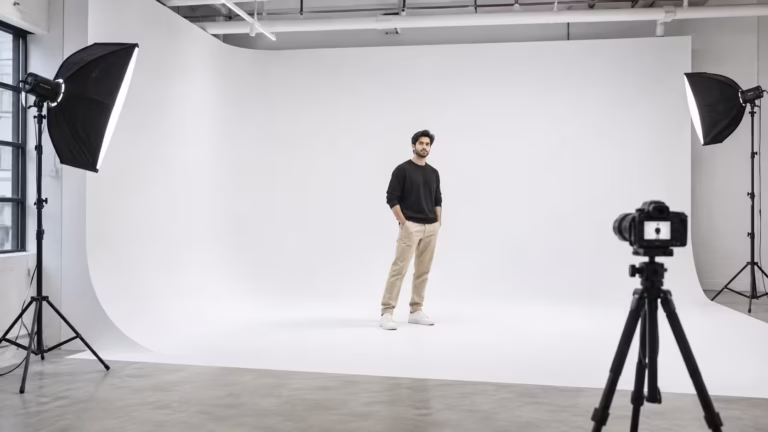
- Pre-production. Book space, gear and crew, confirm load-in and send a call sheet. Our building has a 54 x 84 inch freight door and 12 ft ceilings (as listed on lovestudiosnyc.com, November 2026), so measure set pieces first. Studio 14A, our cyc wall studio with east and south facing windows, has blackout curtains for strobe only work, and extra heads or paper come from our photo and video studio equipment rental list.
- Casting. Put rates and usage into the talent agreement and collect signed releases before the camera fires.
- Shoot day. Shoot tethered so the client approves frames on screen, photograph a color target at each setup and name files to the shot list. Test one or two standard studio lighting setups before the client arrives, so approvals start on time.
- Post-production. Selects, then retouching in a contracted number of rounds, then a color check against the target and the physical product.
- Delivery and asset management. Deliver every crop each channel needs plus a master, and store the license terms and expiry date with the files.
Who owns advertising photos, and what usage rights does a brand need?
Under US law, the photographer owns the copyright in advertising photography unless the photo is a work made for hire or ownership is transferred in a signed written agreement. A brand that hires a freelancer normally receives a license.
The US Copyright Office’s Copyright Basics circular says copyright “initially belongs to the author(s) who created that work” and that transfers of exclusive rights generally must be written and signed. A nonexclusive license needs no written agreement, which is how disputes start: terms agreed on a call are hard to prove.
Circular 30, Works Made for Hire (revised August 2024) sets out two routes. An employee’s photo taken within the scope of the job belongs to the employer. A contractor’s commissioned photo qualifies only if it fits one of nine statutory categories, such as a contribution to a collective work, and both parties sign a written agreement. Photographs are not a category in their own right, so a “work for hire” line in a freelance contract may not make the brand the owner; ask your attorney about a written assignment instead.
Usage terms to agree in writing
- Media: every use, from paid social and shopping to print, out of home, packaging and PR.
- Territory: United States, North America, worldwide or named markets.
- Duration: start and end dates, and what happens to printed or running ads at expiry.
- Exclusivity: whether the photographer may license the same or similar images to others, including competitors.
- Edits: whether you may crop, retouch, composite, add text, animate or create new work from the images, including with AI tools.
- Talent match: releases and talent agreements covering the same media, territory and duration as the photo license.
- License or assignment: which one, and for an assignment, a signed written transfer.
Do you need a model release to use someone’s photo in an ad in New York?
Yes. New York Civil Rights Law section 50 makes it a misdemeanor to use the name, portrait, picture, likeness or voice of any living person for advertising or trade without that person’s written consent, or a parent’s or guardian’s for a minor.
Under New York Civil Rights Law section 50, liability reaches anyone who “uses for advertising purposes, or for the purposes of trade” a living person’s likeness without written consent. Section 51 lets that person sue to stop the use and recover damages, plus exemplary damages if the use was knowing. Releases are where advertising photography meets New York law. In plain terms: get a signed release from everyone in frame, employees and family included, before the shoot, with a scope matching the photo license. This is not legal advice; have an attorney draft or review releases, especially for minors, union talent and campaigns running in other states.
The FTC’s Endorsement Guides, 16 CFR Part 255, add a federal layer: a depicted “likeness” can be an endorsement, and section 255.2(c) says ads presenting people as actual consumers should use actual consumers or clearly disclose that they are not. A model playing “a real customer” needs that disclosure.
How do truth in advertising rules apply to product images?
The FTC says ad claims must be truthful, not deceptive or unfair, and evidence-based, and it reads an ad in context, pictures included. In advertising photography, a photo showing a color, size or result the product does not deliver is a claim like any line of copy.
The FTC’s Advertising FAQs for small business call an ad deceptive if it is likely to mislead consumers acting reasonably and is material, and require proof for express and implied claims before it runs. The Endorsement Guides give photo examples: acne testimonials paired with stock photos of near perfect skin misrepresent results.
The working rule: clean the product, never change it. Removing dust and scratches is housekeeping; changing shape, color, texture, size or the visible result is a claim. Match color to the physical product, show only what comes in the box or label props as not included, and remember a wide lens close up makes a small product look bigger. Before and after imagery needs counsel first.
What does a half day advertising shoot cost in a NYC studio?
At November 2026 rates, a four hour product shoot in Studio 14A with one rented Profoto monolight, one seamless paper color, the background setup fee and the cleaning fee costs $497.00 before sales tax, with the 5% processing fee applied to studio time. Crew, talent and retouching are extra.
Hypothetical brief: a skincare brand needs white background packshots for its product pages and shopping feed, plus two hero frames on colored paper. Studio 14A includes three Flashpoint Rapid 600 II monolights (as listed on lovestudiosnyc.com, November 2026); the team rents a Profoto B1 500 AirTTL, listed at $50, as a fourth head so two lights can stay on the background.
| Line item | Basis (as listed on lovestudiosnyc.com, November 2026) | Amount |
| Studio 14A | $85 per hour x 4 hour minimum | $340.00 |
| Processing fee | 5% x $340.00 studio time | $17.00 |
| Cleaning fee | Shown in the listing’s booking summary | $30.00 |
| Profoto B1 500 AirTTL monolight | As listed; confirm the rental period at booking | $50.00 |
| Seamless paper, one color | Standard 9 ft length | $30.00 |
| Background setup fee | As listed; one background assumed, confirm whether it is charged per booking or per background | $30.00 |
| Studio costs total, before NY sales tax | $497.00 |
The arithmetic: $85 x 4 = $340.00. $340.00 x 0.05 = $17.00, assuming the 5% processing fee is charged on studio time. Cleaning fee $30.00. Add-ons: $50 + $30 + $30 = $110.00. Total: $340.00 + $17.00 + $30.00 + $110.00 = $497.00. NY sales tax is added at checkout.
Time is the bigger risk. Setup and wrap count toward booked hours, and overtime starts 5 minutes after the booking ends at 1.5 times the rate: $127.50 per hour in 14A. A fifth hour booked in advance costs 85.00plusthe5%fee(4.25), or $89.25.
Other costs need real quotes; treat these as hypothetical placeholders to fill in: photographer fee and license, assistant, stylist, model fee, retouching per image. If the job grows to a full crew all day, a flat rate full day production studio booking may suit better than hourly blocks.
You may not need a studio at all. One product for an organic social test can be shot by an office window, and outdoor lifestyle work belongs outdoors. A studio earns its cost when you need repeatable light, a cyc, blackout control or room for a crew.
Frequently Asked Questions
What defines high quality commercial photography?
It is on brief first, delivering the frames, crops and formats requested. Technically it is sharp where it matters, cleanly exposed and color accurate against the real product, with lighting consistent across the set. It also comes with clean rights: signed releases and a written license covering every channel where it will run.
What does a buyout mean in advertising photography?
Buyout has no single legal meaning. Some photographers mean an unlimited license in all media for a long or open term; others mean a full copyright transfer. Because ownership transfers must be in a signed writing, have the contract say plainly which one you get, and list media, territory and duration either way.
Do we need releases from employees who appear in our ads?
Yes. New York Civil Rights Law section 50 requires written consent for advertising or trade use of a living person’s likeness, and being on the payroll is not written consent. Get a signed release covering the campaign’s media and duration, and ask your attorney how to handle images of staff who later leave.
Can AI-generated backgrounds be used in product ads?
Changing a background is different from changing the product, which must still look and perform as it does in real life. Platforms add rules: as of November 2026, Google Merchant Center asks that generative AI lifestyle images keep metadata showing they were AI-generated. Tell your photographer if composites are planned, so the license covers them.
How far ahead should we book a studio for a campaign shoot?
Book once the shot list and talent dates are firm. Under November 2026 terms at Love Studios NYC, one reschedule is free with more than 7 full days’ notice, and cancellations more than 30 days out are refunded in full less the 5% processing fee. From 30 to 7 days out the refund is 50% less the 5% processing fee; inside 7 days, bookings are not refundable.
Bringing it together
Good advertising photography starts with the media plan, not the camera. Write the channels into the brief, shoot to a shot list grouped by setup, keep retouching honest, and put the license and releases in writing with matching scope. Then budget studio time with real rates and an hour of slack.
When your brief is ready, you can check live availability for our daylight and cyc wall studios or email email us with questions.
About this guide: This article is general information for photographers, producers and brands planning shoots in New York City. Studio rates, inclusions and policies mentioned here reflect lovestudiosnyc.com as of November 2026 and can change, so confirm current details on the booking page before you plan around them. Nothing here is legal, tax or employment advice. For union, permit, contract or usage rights questions, check with the relevant official body or a qualified professional.