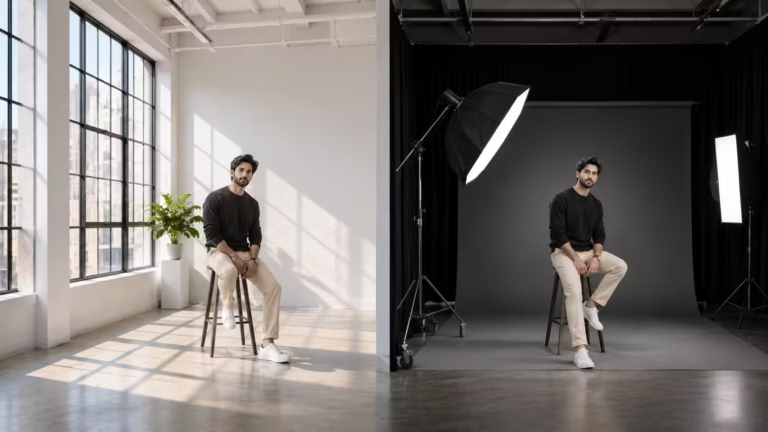
What Is a Cyclorama Wall (Cyc Wall) and When Does Your Shoot Need One?
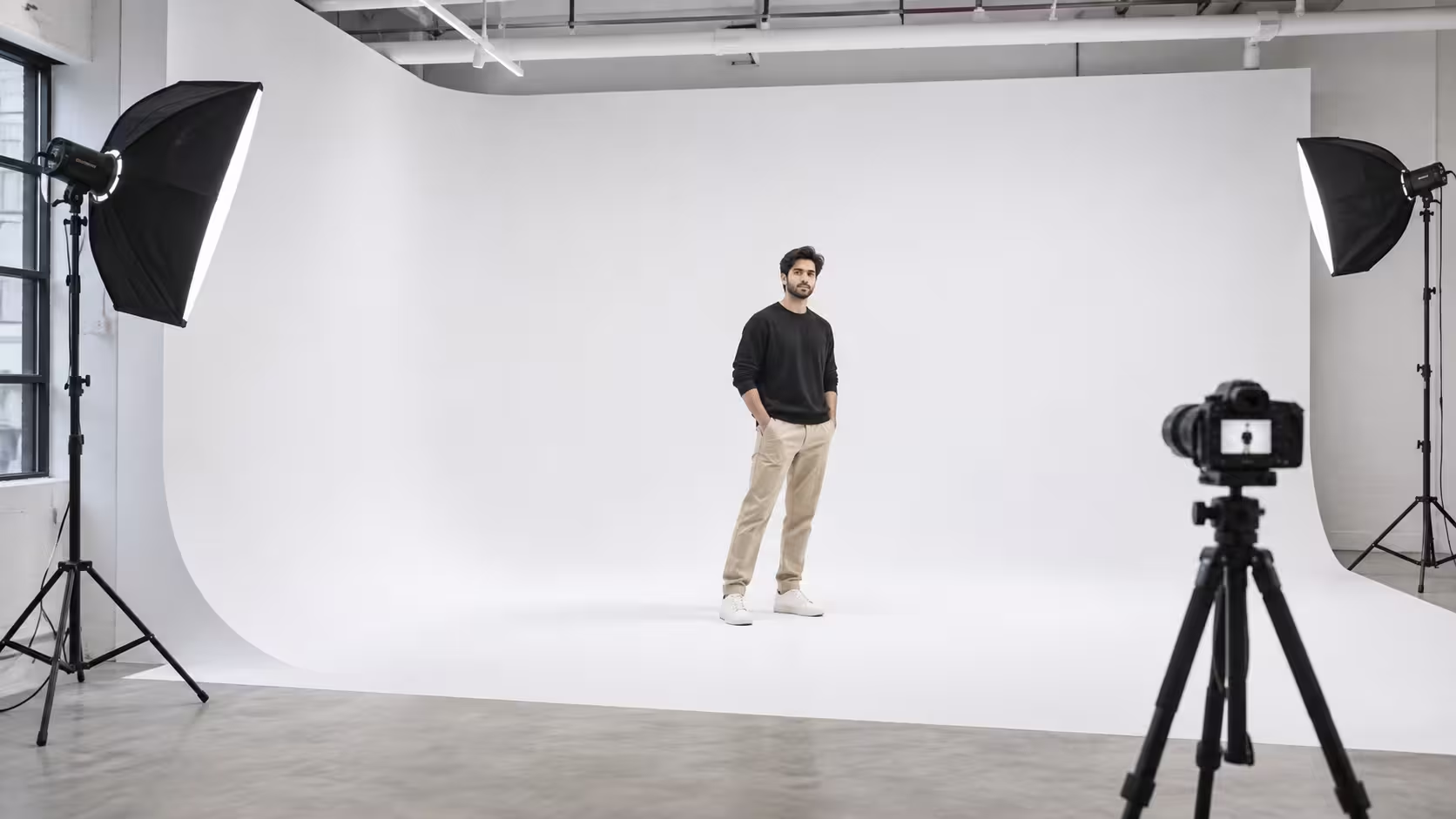
A cyc wall, short for cyclorama wall, is a permanent studio background where the back wall curves down into the floor through a smooth cove, so the camera sees no corner and no horizon line. Lit evenly, a white cyc reads as open white space. Painted chroma green, it becomes a keying surface that runs under the talent’s feet. You need one when the floor is in the frame: full length fashion, dance, video with a moving camera or a wide group. You probably do not need one for tight headshots, small tabletop products or a gray paper portrait, where a standard 9 ft paper pull or a plain white wall does the job. At Love Studios NYC in Midtown Manhattan, Studios 14A, 14C and 16B and the combined 14AB suite are listed with cyc walls, and the cyc is included in the hourly rate.
Key takeaways
- A cyc wall joins the wall and floor with a curved cove painted as one surface, so the join disappears on camera.
- Choose a cyc when the floor shows or the subject moves. Seamless paper still covers most head and shoulders and small product work.
- Light the cyc with its own lights. “Background about one stop over the key” is a starting point to test, not a rule.
- At November 2026 rates, 4 hours on the Studio 14A cyc comes to $387.00 before sales tax (studio time, 5% processing fee and cleaning fee), against $405.00 for a 4 hour paper setup in Studio 14B.
What is a cyc wall?
A cyc wall is a studio background in which the back wall meets the floor in a gradual curve instead of a right angle. Light changes smoothly across that curve, so the joint vanishes and the subject appears to stand in empty space.
It also goes by infinity wall, infinity cove, coved floor, white cyc or just “the cyc” (said “sike”), and a cyclorama studio is simply a studio with one built in. The geometry does the work, not the paint: a flat wall meets the floor at a hard edge the camera reads as a horizon line, while a cove swaps that corner for a radius. Seamless paper pulled onto the floor makes a small, temporary version of the same curve; a cyc is the permanent, wider, walkable one.
Where does the name “cyclorama” come from?
The name comes from the giant circular panorama paintings of the 19th century, called cycloramas in the United States. The theater then borrowed it for a curved backdrop at the rear of the stage.
The English painter Robert Barker patented painting in the round in 1787 and showed his landscapes in Leicester Square, London, according to the National Endowment for the Humanities’ history of the Gettysburg panorama. The best known American example survives: the National Park Service’s page on the Gettysburg Cyclorama records that Paul Philippoteaux painted the first version, which opened in Chicago in 1883, and that the version on display at Gettysburg, first shown in Boston in 1884, is 377 feet long and 42 feet high. Visitors stood on a central platform, surrounded by the painting.
The stage version is the studio cyc’s direct ancestor. Encyclopaedia Britannica’s entry on the cyclorama describes a device introduced early in the 20th century that usually forms “a smoothly curving, concave wall at the rear of the stage”, painted white or light blue to suggest sky or distance. Studios carried that curve down to the floor.
How is a cyclorama wall built?
A cyc has three parts: a wall, a flat floor and a curved cove between them, painted as one surface. Cycs differ in how many walls are covered and whether they are permanent.
The cove is framed with curved forms, skinned, filled, sanded and painted. It is usually the least supported part of the surface, so studios ask that nobody stand or set stand legs on it.
- One wall cyc: a single back wall coved into the floor. The camera works mostly straight on; pan too far and you see the side edge.
- Two wall (corner) cyc: two walls at a right angle with the vertical corner coved too, so you can shoot into the corner on a diagonal and gain apparent width.
- Three wall cyc: a U shape that lets the camera swing through a wide arc, suited to video and vehicle work.
Hard cyc vs soft cyc
A hard cyc is permanent construction: walkable, repaintable, fixed in place. A soft cyc is fabric or vinyl stretched over a frame or hung in a curve. It travels to locations without a built cyc, but wrinkles and seams need managing and it is rarely as walkable.
White, black or chroma green?
- White: the default for e-commerce, fashion, beauty, music videos and advertising. Underexpose it and it records gray; light it with gels and it takes on color.
- Black: for low key looks and rim lit products. An unlit white cyc goes dark gray rather than black, because subject light spills onto it.
- Chroma green or blue: for keying talent head to toe; pick the color absent from the wardrobe. Rosco’s chroma key paint data sheet lists a matte finish and coverage of approximately 300 square feet per gallon, and recommends re-priming with white before repainting because the white undertone improves luminance.
The cyc walls listed at Love Studios NYC are white, so email the team before booking a chroma key shoot.
Cyc wall vs seamless paper vs a painted flat wall
A cyc wins when the floor is visible, the subject moves or you need width. Seamless paper wins on color choice, and on cost only when the paper room has a lower rate or a shorter minimum. A painted flat wall suits frames above the waist. Paper against cloth is a separate decision, with its own tradeoffs when choosing between seamless paper and a fabric backdrop.
| Factor | Cyc wall | Seamless paper | Painted flat wall |
| Setup | Ready on arrival; lighting the wall is the main job | Hung, pulled and taped before lighting | None, but framing must hide the corner |
| Usable width | The cyc’s width (Studio 14A: 12 ft wide, 15 ft deep) | The roll’s width; the standard pull here is 9 ft | The wall’s width, with a different floor |
| Cost per use at Love Studios NYC (November 2026) | Included in the studio rate; optional fresh paint ($120 on 14A, $100 on 14C and 16B) | $30 per color for a standard 9 ft pull, plus a $30 background setup fee | Included in the studio rate where the studio has a white wall |
| Floor in frame | Yes, the cove hides the join | Yes, until the paper creases or tears | No, the corner shows |
| Wear and reuse | Footprints and scuffs build up; repainted monthly | Torn off when dirty; each color is a new pull | Scuffs at the base; touched up |
| Best for | Full length, movement, video, groups, chroma key with floor | Head and shoulders, brand colors, small product | Headshots, seated interviews |
How do you light a white cyc evenly?
Light the cyc with its own lights, separately from the subject, and get the wall even before anyone steps in. For pure white, keep the wall slightly brighter than the subject, keep the subject forward of the curve, and flag the background lights away from the lens. Treat the figures below as starting points.
- Light the empty wall first. Put at least one light on each side, aimed across the cyc from behind V-flats or flags, beams overlapping in the center. Check left, center and right, then the floor and cove, which often read darker.
- Set the ratio. Start with the wall about one stop brighter than the key on the subject, going to 1.5 or 2 stops if the white still looks gray. Push further and light bounces back at the lens, wraps the subject’s edges and flattens contrast.
- Keep the subject off the curve. Stand talent on the flat floor, well forward of the cove, to limit spill and flare on their edges. On a 15 ft deep cyc like 14A’s, full length frames leave limited room, so flags do more work.
- Flag the flare. A black flag or the black side of a V-flat between each background light and the lens, plus a lens hood, stops the haze an overlit cyc causes. Studio 14A includes two V-flats.
- Check zone by zone, then pick a lens. Use the highlight warning on wall, floor and cove. A longer lens takes in less background, so a 12 ft wide cyc fills more of the frame and the top of the wall stays out of shot under 12 ft ceilings.
Daylight drifts in brightness and color, and 14A’s blackout curtains shut it out. Once the wall is even, build the subject light with one of the standard studio lighting setups, measured from the key outward.
Green cycs need tighter tolerances. A BBC engineer’s account of virtual studios in the EBU Technical Review says the keyed area “needs to be evenly lit” and the artist should stand “as far away as possible from the background”.
When do you not need a cyc wall?
You do not need a cyc when the floor never enters the frame, when the background is narrower than a paper pull, or when you want a texture or exact color a white cyc cannot give.
- Tight headshots. A head and shoulders frame shows a few feet of background, so paper or a white wall does the job.
- Small tabletop product. A tabletop sweep suits jewelry and cosmetics. A cyc earns its place on product days when apparel goes on models at full length, which matters when you are shooting a catalog of 100 or more SKUs in one day.
- Gray paper portraits. A white cyc lit to gray shifts tone as light falls off; gray paper holds one value from session to session.
- Textured looks. Painted canvas, brick or a real location carry a mood a cyc deliberately removes.
Do I need a cyc? A five question check
- Will the floor or the subject’s feet appear in the frame? If yes, book a cyc.
- Is your background wider than a 9 ft pull cover at your focal length? If yes, book a cyc wider than the pull, such as 14A’s 12 ft.
- Will the subject move (walking, dance, children, pets) or the camera move (gimbal, slider)? If yes, book a cyc; paper creases under traffic.
- Do you need a chroma key that includes the floor? If yes, ask about a green cyc first.
- Do you need one exact paper color, such as a brand color? If yes, choose paper.
If every answer is no, paper or a white wall will do the job, so pick the room for its light, size and minimum instead.
Worked example: a cyc studio vs a paper setup at November 2026 rates
Here is a hypothetical one model shoot priced two ways, at rates as listed on lovestudiosnyc.com, November 2026. We assume the 5% processing fee is charged on studio time. NY sales tax is added at checkout and is not shown.
Option A: Studio 14A cyc wall ($85 per hour, 4 hour minimum)
- Studio subtotal: 4 hours x $85 = $340.00
- Processing fee: 5% x $340.00 = $17.00
- Cleaning fee shown in the listing’s booking summary: $30.00
- Pre-tax total: $340.00 + $17.00 + $30.00 = $387.00
- With fresh paint on 14A ($120): $387.00 + $120.00 = $507.00
Option B: Studio 14B with seamless paper ($75 per hour, 4 hour minimum; the listing does not describe a cyc wall)
- Studio subtotal: 4 hours x $75 = $300.00
- Processing fee: 5% x $300.00 = $15.00
- Paper and setup: $30 pull + $30 background setup fee = $60.00
- Cleaning fee shown in the listing’s booking summary: $30.00
- Pre-tax total: $300.00 + $15.00 + $60.00 + $30.00 = $405.00
Option A costs 18.00lessthanOptionBwithoutfreshpaint(405.00 minus $387.00) and 102.00morewithit(507.00 minus $405.00).
Both rooms carry a 4 hour minimum, so the cyc’s $10 higher hourly rate is offset by skipping the paper, and each extra paper color in Option B adds another $30 pull. Hanging and taping paper also uses booked time. Studio 14C, a daylight studio with a white cyc wall, is listed from $70 per hour with a 3 hour minimum (November 2026 rate), so 3 hours on its cyc would come to $210.00 + $10.50 = $220.50 before tax, and a cleaning fee may appear in the booking summary. Its listing does not state cyc dimensions, so ask us to confirm it covers your frame.
Setup and wrap count toward booked hours, and overtime starts 5 minutes after the booking ends at 1.5 times the rate: $127.50 per hour on 14A.
How should you care for a cyc wall during a shoot?
Treat the cyc floor as part of the set: shoes off or covered, no dragging gear, careful taping, and fresh paint booked when the floor fills the frame.
- Footwear. The crew wears shoe covers or clean socks; talent changes into shooting shoes at the edge. In a New York winter, slush and sidewalk salt mark white paint almost at once.
- Stands and carts. Lift, never drag. Keep stand legs and sandbags off the cove, and sandbag every stand.
- Tape. Use low tack tape for marks and pull it at wrap; strong cloth tape can lift paint.
- Food and drink. Keep them off the cyc.
- Repaint timing. Our cyc walls are painted monthly, so ask when yours was last done.
Cyc wall studios at Love Studios NYC: what to know before you book
These studios at 545 8th Avenue are listed with cyc walls. The 14A and 16B listings publish cyc dimensions; the others do not. All share 12 ft ceilings and a 54 x 84 inch freight door.
- 14A: the white cyc wall studio on the 14th floor: a cyc 12 ft wide and 15 ft deep, five oversize east windows and two south, blackout curtains, three Flashpoint Rapid 600 II monolights and a Nanlite FS 300 LED.
- 14C: a daylight studio with a white cyc wall at a lower hourly rate.
- 16B: a daylight studio with a cyc wall on the 16th floor, with a white cyc listed as 9 ft wide and 11 ft deep (November 2026), the same width as a standard paper pull.
- 14AB: a combined suite with a cyclorama wall, with an 8 hour minimum, booked by email.
You may bring your own lights, but stands, sandbags, boom arms and grip are rented from the studio. Studio managers are on site.
Frequently Asked Questions
Is a cyc wall the same as an infinity wall?
Mostly, yes. Infinity wall, infinity cove, coved floor and cyc all describe a background where the wall curves into the floor. Some crews use “infinity cove” for the curve alone and “cyc” for the whole structure. The names say nothing about size, so ask for width, depth and how many walls are coved.
Why does my white cyc look gray in photos?
Usually the wall is underexposed relative to the subject, or the floor gets less light than the wall. Check wall, floor and cove separately with the highlight warning. Raise the background lights or angle them toward the floor, and close the blackout curtains if daylight is uneven. Your exposure for the subject decides how bright the wall records.
Can I use a white cyc for video?
Yes. A white cyc suits interviews, product spins and dance, and continuous LEDs let you judge evenness by eye. Two cautions. A hard cyc is a reflective surface, so voices can sound roomy without sound blankets. And check LEDs for flicker at your frame rate and shutter speed before you roll.
Do I need to book the fresh paint add-on?
Book it when the floor fills a large part of the frame, as in full length e-commerce, wide video or a group shot, or when you want minimal retouching. Our cyc walls are repainted monthly, so the surface depends on where your date falls in that cycle. Ask when the cyc was last painted, then weigh the fee ($120 on 14A, $100 on 14C and 16B) against retouching time.
Can large sets or a car go on the cyc?
The freight door measures 54 x 84 inches, and the freight elevator interior is listed as 73 x 76 x 100 inches, so anything larger has to break down to fit. That rules out a full size car and large one piece flats, while modular sets and furniture can come in. Measure your largest piece and email email us if you are unsure.
The short answer
A cyc wall solves one problem: making the floor and the corner disappear. If your frame shows feet, floor or movement, a cyclorama wall is worth booking. If it does not, paper or a plain wall will do, often in a room with a lower rate or a shorter minimum, and we would rather you book that. When your shot list does call for a cyc, you can check live availability for our daylight and cyc wall studios.
About this guide: This article is general information for photographers, producers and brands planning shoots in New York City. Studio rates, inclusions and policies mentioned here reflect lovestudiosnyc.com as of November 2026 and can change, so confirm current details on the booking page before you plan around them. Nothing here is legal, tax or employment advice. For union, permit, contract or usage rights questions, check with the relevant official body or a qualified professional.