Daylight Studio vs Blackout Studio: Which Suits Your Shoot?
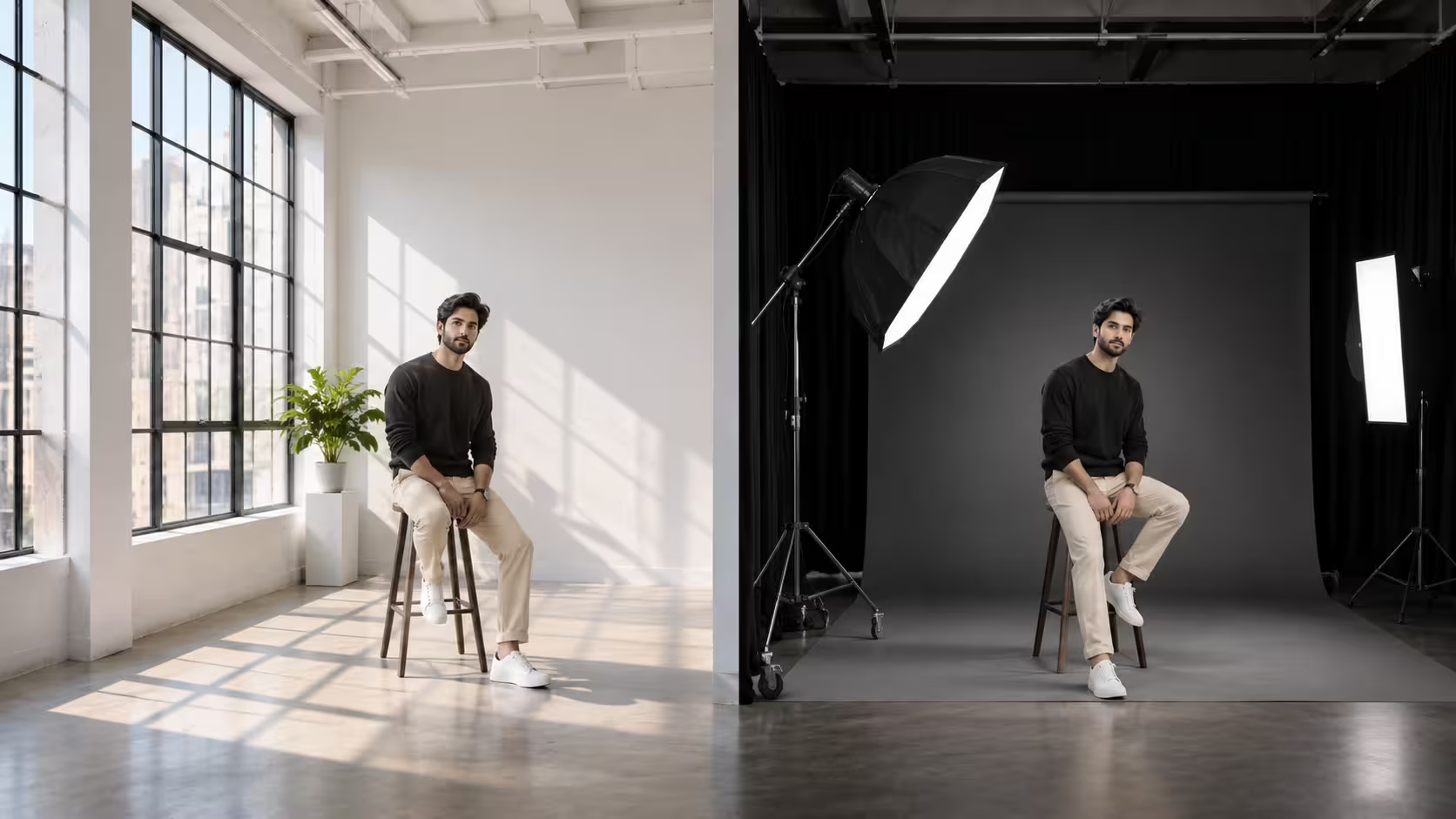
A daylight studio uses big windows as its main light source, so the look shifts with the hour, the season and the weather. A blackout studio keeps outside light out, and every light in the frame is one you placed. Book a daylight studio when you want soft, natural looking light and can plan around the sun. Book blackout control when the result has to match at 10 a.m. and at 6 p.m., across several days, or in every frame of a video. Many rooms sit in between. At Love Studios NYC our daylight rooms have blackout curtains and strobes on site, so you can start with window light and close the room when the sun drops. In New York in late November, that drop comes before the 4:30 p.m. sunset.
Key takeaways
- Daylight is soft and quick to set up, but it changes constantly and is gone by late afternoon in winter.
- Window direction sets when direct sun arrives: east mornings, west afternoons, south most of the day.
- New York gets about 15 hours of daylight on 21 June 2026 and about 9 hours on 21 December 2026 (US Naval Observatory).
- Catalog, multi day campaign and video work usually favors controlled light; portraits and editorial often favor windows.
- A daylight studio with blackout curtains lets you shoot both, as long as you do not mix the two sources by accident.
What is a daylight studio, and what is a blackout studio?
A daylight studio is a rental space built around large windows, where natural light is the main source and artificial lights support it. A blackout studio excludes outside light, because the room has no windows or they are fully covered, so you control every source.
A big window behaves like a very large light source that wraps gently around faces and products, and you can shoot within minutes of walking in. The tradeoff is a light that moves, dims and changes color on its own schedule. In a blackout room nothing changes unless you change it, so the last frame matches the first, but every look is built from scratch with more gear and time.
The hybrid: a daylight studio with blackout curtains
Many rental studios work this way: you shoot window light while it is good, then close the curtains and switch to strobes or LEDs. All five daylight rooms below list blackout curtains, and every Love Studios NYC studio includes Flashpoint strobes and Nanlite LEDs with stands, modifiers and grip (as listed on lovestudiosnyc.com, November 2026). If the real question is studio photography vs location photography, settle that first.
How does window direction change the light in a daylight studio?
Window direction decides when direct sun enters and when you get soft, indirect skylight. In New York, south facing windows take direct sun for much of the day, north facing windows give softer and steadier light, east windows are strongest in the morning and west windows in the afternoon.
This follows from the sun’s path across the southern sky in the Northern Hemisphere:
- South facing: sees the sun for much of the day. Low winter sun reaches deep into the room, so plan diffusion for soft portraits.
- North facing: mostly indirect skylight, the classic painter’s light because it shifts less, though dimmer and cooler.
- East facing: direct, angled sun in the morning, softer light after the sun moves past.
- West facing: soft in the morning, then lower, warmer direct sun through the afternoon. This is where indoor “golden hour” light comes from, if nothing blocks it.
On a Midtown block, a tower across the street can cut off low sun well before sunset or bounce light back in at odd angles. Ask the studio manager on site what a window does at your hour and season.
Our daylight rooms by window direction
As listed on lovestudiosnyc.com, November 2026:
- Studio 22A, an east and south facing daylight room with three windows each way, suits morning and midday bookings.
- Studio 23B, our south and west facing natural light studio with four windows each way, carries light later into the afternoon.
- Studio 16A, a south facing daylight studio from $55 an hour (3 hour minimum) has four south windows and is the lower cost option.
- Studio 14A, which pairs a cyc wall with east and south daylight, has five east and two south windows and a 12 ft wide by 15 ft deep cyc (from $85 an hour, 4 hour minimum).
Studio 16AB, booked on request, has four south and two east windows.
All five list blackout curtains. None face north, so on a clear day expect direct sun at some point and plan diffusion.
How much daylight do you get in New York in winter?
Far less than in summer. New York gets about 9 hours 15 minutes between sunrise and sunset on 21 December 2026, against about 15 hours 6 minutes on 21 June 2026, and usable light inside a studio is shorter than either.
Times for our address (545 8th Avenue, Manhattan), from the US Naval Observatory sun and moon data service, retrieved 20 November 2026:
| Date | Sunrise | Sunset | Time between |
| Sunday 21 June 2026 | 5:25 a.m. EDT | 8:31 p.m. EDT | 15 h 6 min |
| Friday 20 November 2026 | 6:49 a.m. EST | 4:34 p.m. EST | 9 h 45 min |
| Saturday 28 November 2026 | 6:58 a.m. EST | 4:30 p.m. EST | 9 h 32 min |
| Tuesday 8 December 2026 | 7:07 a.m. EST | 4:28 p.m. EST | 9 h 21 min |
| Monday 21 December 2026 | 7:17 a.m. EST | 4:32 p.m. EST | 9 h 15 min |
June gets 5 h 51 min more than 21 December.
Sunset describes the sun at the horizon; inside a room on a tall block the light falls off earlier. Note too that the 21 December day is 17 minutes shorter than 28 November, yet sunset is two minutes later, because sunrise has moved 19 minutes later. The earliest sunsets of the year come in the first half of December, not on the shortest day. A 5 p.m. natural light booking is easy in June; in winter it is a strobe booking.
Why does daylight color shift, and what goes wrong with mixed lighting?
Daylight is not one color. Its color temperature changes through the day and with the weather, so a white balance that looks right at noon can look blue in shade or orange near sunset, and windows mixed with strobes or LEDs can put two colors on one face.
Color temperature is measured in kelvins, lower numbers warmer and higher numbers cooler; our photography lighting tips on color temperature and light quality cover the basics. The drift is the point here:
- The International Commission on Illumination (CIE) defines standard illuminant D65 to represent average daylight, at a correlated color temperature of approximately 6,500 K (ISO/CIE 11664-2:2022). The key word is average.
- A 1999 study in Applied Optics, built on nearly 7,000 measured daylight and skylight spectra, notes that natural outdoor light “daily undergoes large changes in its correlated color temperature,” with daylight and skylight spanning about 3,000 K to far above 10,000 K.
- The US Department of Energy’s lighting principles and terms gives “light from an overcast sky” as its example of cool light.
In practice, a sunny west window late in the day reads warm and a gray afternoon reads cool.
The mixed light problem
Your camera can correct for one color of light, not two. When window and studio light hit the subject at different colors, you get neutral skin on the lit side with blue shadows from skylight, a warm window rim against a cooler strobe key, video takes that drift as clouds pass, and window shapes reflected in glossy products.
Decide which source is in charge. Let one dominate and keep the other well below it, close the curtains fully when you switch to strobes, set bi-color LEDs to match the window, and shoot a gray card at every lighting change. For stills, shoot RAW.
Why do catalog, campaign and video shoots usually favor controlled light?
Because they have to match. An e-commerce grid, a two day lookbook or an interview cut from several takes falls apart when the light changes between frames.
The shirt shot at 10 a.m. must sit next to the shirt shot at 3 p.m. on the same white page. Behind closed curtains, the strobes make that automatic; by a window, every SKU needs correcting. Our catalog photography workflow for shooting 100 or more SKUs in a day assumes controlled light for this reason. A campaign shot across Tuesday’s sun and Wednesday’s cloud will not match either. Video is the strictest case: light the interview with the curtains closed, and use the windows for B roll.
Daylight studio vs blackout studio: how do they compare?
The daylight studio wins on softness, speed and a natural look; the blackout studio wins on control and repeatability. The hybrid room gives you both in separate sets.
| Factor | Daylight studio | Blackout studio | Daylight studio with blackout curtains |
| Control | Low: you shape what the sun provides | Full: every source is yours | Window light first, full control after |
| Consistency across hours | Changes with sun, season and cloud | Identical first frame to last | Consistent once curtains close |
| Setup speed | Fast for simple looks | Slower: every look is built | Fast start, strobes pre-set for later |
| Look and mood | Soft, airy, natural | Anything you can light, bright to very dark | Both, in separate sets |
| Weather risk | High | None | Low: strobes are the backup |
| Best shoot types | Portraits, editorial, lifestyle, food | Catalog, video, reflective products, night looks | Mixed shoot lists, winter bookings |
| Wrong choice when | You need late winter light or exact matching | You want real window light with little gear or crew | You need a room with no windows at all |
Which should you book for your shoot type?
Match the studio to what the images must do. If every frame has to match, choose control; if the brief calls for softness and the schedule fits the sun, book daylight.
| Shoot type | Our usual call | Why |
| Fashion editorial | Daylight, curtains as backup | Window light suits texture and movement; frames can vary |
| Portraits and headshots | Daylight for a natural look; controlled light for team sets | A team page shot across a day needs identical light |
| E-commerce catalog | Curtains closed or blackout | Every SKU must match |
| Beauty close-ups | Either: big window for natural skin, strobes for precise detail | Close framing shows any color drift |
| Video interviews | Curtains closed, LEDs | Continuity across takes |
| Reflective products | Blackout | Windows appear as reflections |
| Moody or night looks | Blackout | Daylight spill kills deep shadows |
Worked example: a 3 hour natural light portrait in Studio 23B, late November 2026
Hypothetical booking: a portrait photographer wants window light on Saturday 28 November 2026 (US Naval Observatory sunset: 4:30 p.m. EST). Studio 23B is from $75 an hour with a 3 hour minimum (as listed on lovestudiosnyc.com, November 2026).
Choosing the hours. Indoor light on a Midtown block drops before sunset. The south windows carry the middle of the day and the west windows take over later, so the photographer books 1:00 p.m. to 4:00 p.m. and plans to finish window looks by 3:40. Setup and wrap count toward booked hours:
- 1:00 to 1:30 p.m.: load in, and set one included strobe as a backup key in a deep parabolic.
- 1:30 to 3:00 p.m.: main looks by the south windows; keep the subject out of any direct sun patch or diffuse the glass.
- 3:00 to 3:40 p.m.: warmer, lower light from the west windows, if the buildings opposite allow. Gray card at each change.
- 3:40 to 3:50 p.m.: if the light fades, close the blackout curtains fully and finish on the strobes instead of mixing a dimming window with flash.
- 3:50 to 4:00 p.m.: pack down. Overtime starts at 4:05 p.m.
The cost (November 2026 rates), assuming the 5% processing fee is charged on studio time:
- Studio: 3 hours x $75 = $225.00
- Processing fee: $225.00 x 0.05 = $11.25
- Cleaning fee shown in the listing’s booking summary: $20.00
- Pre-tax total: $225.00 + $11.25 + $20.00 = $256.25
NY sales tax is added at checkout.
If it might run long. Overtime is 1.5 times the rate, $112.50 an hour here. A fourth hour booked in advance costs 4 x $75 = $300.00 plus a $15.00 processing fee and the same $20.00 cleaning fee, or $335.00 before tax: $78.75 more than the 3 hour total, and less than one overtime hour. In late November, though, 4:00 to 5:00 p.m. is strobe time, not window time.
When is a daylight studio the wrong booking?
When the light you need will not be there, or will change too much to use:
- Late winter afternoon slots that still expect window light. From November to January, a 4 p.m. start is a lit shoot.
- Catalog grids, long video interviews, night looks and reflective products, for the reasons above.
- A fixed date where sun is the whole concept. If cloud would ruin it, plan a lit version too.
A daylight room with closed curtains still works for these, but you pay for windows you will not use. If you need a room with no windows, ask before you book.
Frequently Asked Questions
Can a daylight studio with blackout curtains get fully dark?
Closed blackout curtains cut window light down far enough for most strobe and LED work, but how dark a room gets depends on the curtains, the gaps at their edges and how bright it is outside. For a true low key or night look, close everything during setup, take a test frame with your lights off at your working settings, and tape or flag any leaks you see.
Which is the most affordable natural light studio at Love Studios NYC?
Studio 16A has the lowest listed hourly rate of our daylight rooms: from $55 an hour with a 3 hour minimum (November 2026 rate). It has four south facing windows, blackout curtains, two Flashpoint Rapid 600 II monolights and two Nanlite FS 300 LEDs. Assuming the 5% processing fee is charged on studio time, 3 hours come to $165.00 plus $8.25, plus the $25.00 cleaning fee in its booking summary: $198.25 before NY sales tax.
What should I do if it is overcast on my daylight shoot day?
Overcast skies give soft, even light that many portrait photographers like, but it is cooler in color and fades earlier in the afternoon. Shoot a gray card, warm your white balance if needed, and start window looks earlier. If you need sun for the concept, Love Studios NYC allows one free reschedule with more than 7 full days’ notice; a second change carries a 50% fee (November 2026 terms).
What time should I book a natural light shoot in December?
In New York on 21 December 2026, the US Naval Observatory gives sunrise at 7:17 a.m. and sunset at 4:32 p.m. EST. For window light, aim for a booking that starts mid morning and ends by about 3:30 p.m., and check which way the windows face: east rooms are strongest early, south and west rooms later.
Can I shoot natural light and a cyc wall look in one booking?
Yes, in Studio 14A. It has a white cyc wall 12 ft wide and 15 ft deep, five east facing and two south facing windows, and blackout curtains, listed from $85 an hour with a 4 hour minimum (November 2026 rate). Shoot window light looks first while the east light is strong, then close the curtains for controlled cyc work.
The short answer
Book a daylight studio when soft window light helps the images and the schedule fits the sun; book controlled light when frames must match. From November through January in New York, plan window work for midday and keep strobes ready after about 3:30 p.m.
When you know your date and look, check live availability for our daylight and cyc wall studios and pick the room whose windows face the right way for your hours.
About this guide: This article is general information for photographers, producers and brands planning shoots in New York City. Studio rates, inclusions and policies mentioned here reflect lovestudiosnyc.com as of November 2026 and can change, so confirm current details on the booking page before you plan around them. Nothing here is legal, tax or employment advice. For union, permit, contract or usage rights questions, check with the relevant official body or a qualified professional.