
How to Calm Nerves Before an Audition: What Works in the Holding Room
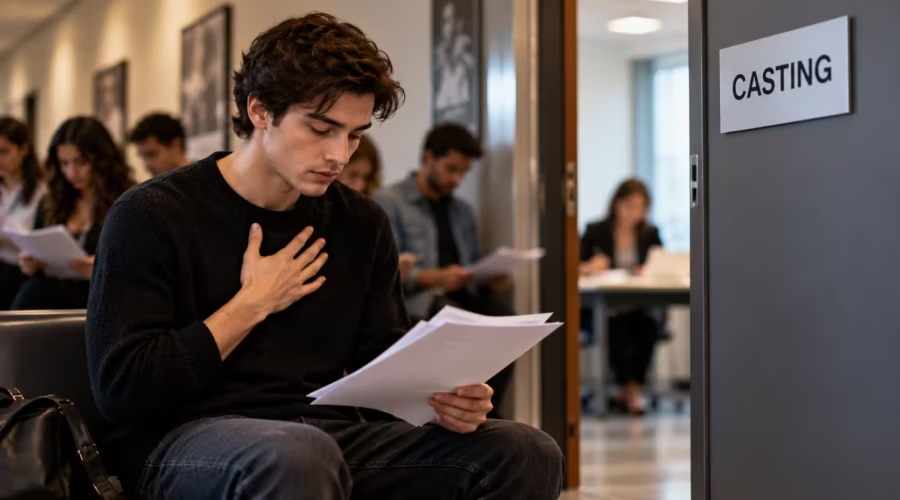
The holding room tells you more about audition nerves than any article does. Twenty people on floor 22, one bench, a radiator that clanks. Somebody is pacing by the window. Somebody else has read the same six lines of sides forty times and stopped seeing the words. If you want to know how to calm nerves before an audition, that hallway is where the answer has to work.
We run casting rooms on floors 14, 16, 22 and 23 at 545 8th Avenue in the Garment District, and we watch sessions from the door. Who walks out loose. Who walks out apologising. Every technique below carries a timing and a mechanism, because one without those is a slogan.
Why auditions trigger nerves even for experienced actors
Auditions put social evaluation, a short window and an outcome you do not control into ten minutes, which is close to a textbook description of what the nervous system reads as threat. Experience changes how long the feeling lasts. It does not remove the trigger.
Performance anxiety, the physical and mental response to being watched and judged while doing something difficult, is not a beginner’s problem. Stage fright, the older theatre word for the same state, turns up in actors with twenty years of credits.
Chasing zero nerves makes it worse. The Yerkes-Dodson law, named after the psychologists Robert Yerkes and John Dodson and catalogued by the American Psychological Association, describes performance against arousal as an upside-down U: flat at too little activation, coming apart at too much, workable in between. We have watched readings given by people who reached genuine indifference. They were boring, and a room notices boring faster than a shaking hand. Get off the far right of that curve, not off it.
What is actually happening in your body in the holding room
Your autonomic nervous system, the part that runs heart rate, digestion and breathing without you deciding anything, has shifted toward sympathetic arousal, the branch that mobilises you for physical effort. Adrenaline rises, blood moves to the large muscle groups, breathing climbs into the chest and speeds up, saliva production drops.
Read that list again: those are the symptoms people describe in our hallway. Dry mouth is reduced saliva. Cold fingers are redirected blood flow. A cracking first line is a breath cycle gone high and tight, so the vocal folds work on an unsteady column of air. Plumbing, not a character flaw.
The counterweight is the parasympathetic branch, carried largely by the vagus nerve, which runs from the brainstem down to the gut and brakes heart rate most strongly during exhalation. You cannot order it on. You can feed it an input it answers, and in a crowded holding room your breath is the only one you control.
How to calm nerves before an audition in the last ninety seconds
Breathe with a long exhale, then put your attention on one point of physical contact. Ninety seconds of that takes the top off the spike. It will not make you serene, and anyone promising serenity in a minute and a half is selling something.
The sequence, standing, no props:
- Seconds 0 to 45. Five rounds of cyclic sighing. Inhale through the nose, take a second short sip on top to fill the lungs, then let a long slow exhale out through the mouth until you are empty. The exhale runs twice the inhale and is never forced.
- Seconds 45 to 65. Weight into the heels, forward into the balls of the feet, then settle in the middle. Name three things you can feel: the floor, the sides paper, your collar. That is somatic grounding, using sensation to pull attention out of a predicted future and into the present.
- Seconds 65 to 80. Say the first line under your breath at the volume you plan to use inside. Not louder, not a whisper. You are checking the pitch you will start on, which is what cracks.
- Seconds 80 to 90. One sentence out loud, quietly: I am excited. Research below.
What breathing pattern works fastest, and why
Cyclic sighing, also called the physiological sigh, is the double inhale and long exhale above. It has the strongest direct evidence for lowering arousal and is easiest to run unnoticed.
A randomised controlled trial led by Melis Yilmaz Balban, David Spiegel and Andrew Huberman at Stanford Medicine compared three breathing protocols against mindfulness meditation in 108 volunteers, each practising five minutes a day. Cyclic sighing produced the largest daily improvement in positive mood, and its group showed the clearest drop in resting respiratory rate against meditation. The breathing groups averaged a 1.91 point daily rise in positive affect against 1.22 for meditation. The paper is published in Cell Reports Medicine and free to read in full, and Stanford Medicine’s write-up sets out all three protocols plainly.
Be clear about what that tested: five minutes a day for thirty days, not a ninety second dose in a hallway on 8th Avenue. The mechanism carries across: calming comes mostly from the long exhale, the phase where vagal braking slows the heart, so lengthening the exhale works with your physiology and a sharp gulp of air at the door works against you.
Box breathing, an equal count of inhale, hold, exhale, hold, four seconds each, was also in the trial and reduced state anxiety, as every group did. Its counting crowds out rehearsed failure, which suits a long wait. Diaphragmatic breathing is a correction, not a pattern: belly and lower ribs expand, shoulders stay still. Most people under pressure do the reverse.
How to stop a shaking hand, a dry mouth or a cracking voice
Each symptom has a cause and an answer, and none involve hurting yourself. Ignore anything about ice, cold shock or snapping a band on your wrist.
A shaking hand. Give it a job. Hold the sides with both hands at waist height, thumbs on the back of the page, because shaking is far more visible when a hand floats. Thirty seconds before you go in, press your palms together firmly for five seconds and release, twice. That is a compressed version of progressive muscle relaxation, tensing a muscle group deliberately then releasing it, group by group through the body. The National Center for Complementary and Integrative Health reviews the evidence on relaxation techniques, including a review that found it promising for anxiety.
A dry mouth. Small sips of room temperature water fifteen minutes out, and again two minutes out, rather than a bottle at the door. Press the tongue gently to the roof of the mouth and release a few times to prompt saliva. The usual mistake is the iced coffee with syrup finished in the elevator.
A cracking voice. Won before you reach the building. Hum and do lip trills on the walk from Penn Station, quietly, for three or four minutes. Then start the first line on the pitch you practised, at the volume the room needs. Pushing volume into a small casting room on floor 14 is what snaps a voice.
What cognitive reappraisal is and how to use it before a read
Cognitive reappraisal means changing the label you put on a feeling rather than suppressing it. For auditions, the version with evidence behind it is relabelling nerves as excitement, because both are high-arousal states.
Alison Wood Brooks, then at Harvard Business School, ran experiments published in the Journal of Experimental Psychology: General. In the karaoke study, people who declared excitement scored 80 percent on pitch, rhythm and volume, against 69 percent for those who said they were calm, angry or sad, and 53 percent for the ones who said they were anxious. The American Psychological Association’s release on the research adds a maths experiment where the group told to get excited scored 8 percent higher than the calm group and the control, and a public speaking study where evaluators rated the excited group as more persuasive and more relaxed.
Those were lab tasks, not casting sessions, and the effects are modest. What makes it worth doing is the cost: one sentence, nothing lost if it fails. Say it aloud, because every version of the research used a spoken statement.
Do not try to talk yourself down at the same time. Telling yourself to relax asks your body for a change it cannot make on command, and failing becomes a second thing to be anxious about.
How to build a pre-audition routine that is repeatable
A pre-performance routine is a fixed, short sequence you run in the same order every time before you perform. It works through familiarity, becoming the one predictable thing in an unpredictable day. Three rules decide whether yours survives. Portable, because you will run it in a stairwell. No equipment. Short enough that a session running an hour behind cannot break it. Run the full read at least twice while your heart rate is up, after a flight of stairs, so the first time you perform anxious is not the audition.
Thirty minutes out
Sign in, find out where you sit in the order, sit down. Two minutes of box breathing. Read the sides twice at normal speed, then put them face down. Humming and lip trills, three minutes. Water. The bathroom, whether you need it or not, because you will be called the moment you leave the room.
Five minutes out
Stand up. Standing changes your breathing more than you expect, and it stops the slow collapse of posture that forty minutes on a bench produces. Shoulders and jaw: tense five seconds, release. Walk the hallway once, then leave the scene alone.
Sixty seconds out
The ninety second sequence above, unchanged, then hold the sides with two hands and go in.
Which technique to use when
| Technique | How fast it acts | What it is good for | Can you do it unnoticed |
| Cyclic sighing | 30 to 90 seconds | Taking the top off a spike, lowering breathing rate | Yes, if the exhale is quiet |
| Box breathing | 2 to 5 minutes | A long wait, or a looping mind | Yes, counting is invisible |
| Diaphragmatic breathing | Ongoing, not a reset | Breath support for the voice | Yes |
| Progressive muscle relaxation, full body | 10 to 20 minutes | The night before, or a long gap | No, needs privacy |
| Shoulders and forearms only | 20 to 40 seconds | A shaking hand, a locked jaw | Yes |
| Somatic grounding | 15 to 30 seconds | Attention that has jumped to the result | Yes |
| Cognitive reappraisal sentence | Immediate | The last thirty seconds before the door | Quietly, but say it aloud |
| Humming and lip trills | 3 to 5 minutes | A voice that cracks or sits high | No, do it on the walk in |
What to do the night before and the morning of
The night before is for removing decisions, not adding work. Lines to the point of boredom, then stop. Clothes out on a chair, chosen for the role and the camera rather than for the street, the same logic that applies to picking what reads well in front of a lens for a headshot session. Route checked, including which entrance and which elevator bank.
The morning of, eat something with protein in it. Low blood sugar and sympathetic arousal produce an almost identical set of sensations, and it is miserable to be shaky for a reason a bagel would have fixed. Caffeine raises heart rate and amplifies what you are managing, so have your normal amount, earlier than normal. Then arrive twenty minutes early, not fifty: an hour ahead just builds the thing you came to avoid.
How to recover mid-scene when nerves hit
Finish the sentence you are in. Do not stop mid-line to apologise, because the apology is more disruptive than the wobble, and a reader who has been in that chair since nine has heard a hundred wobbles and registered none.
Then use the next physical action in the scene as your reset. Turning to the reader, putting a prop down, standing up: any real action gives your attention somewhere to go. If the scene has derailed, ask once to go again. The answer is almost always yes.
The slate, where you say your name and sometimes your height and representation to camera at the top, is better used than wasted. It is the only part of the session where you set your own pace, so take the breath there.
How to handle post audition anxiety and rumination
Post audition anxiety is the loop that starts in the elevator: replaying the read, re-deciding your choices, reinterpreting a casting director’s face. Unproductive, because the material you are analysing is not information.
The fix is a hard stop with a container. Before you leave the building, write three lines in your phone: the choice you made, one thing you would do differently, and the word done. The reviewing instinct then has somewhere to land.
Silence is where rumination grows, so set expectations honestly. A callback, a second round where they want to see you again, can arrive in three days or never. No answer is not a verdict.
When audition anxiety is worth taking to a professional
Nerves before an audition are a normal response to being judged. If anxiety is spilling out of audition days into your sleep, appetite, relationships or ability to work, that is worth raising with a GP or a licensed therapist. The National Institute of Mental Health’s page on anxiety disorders describes the difference between occasional worry and anxiety that does not go away, shows up across many situations and gets worse over time.
Performers in New York have somewhere to go. The Entertainment Community Fund, formerly The Actors Fund, offers mental health services including assessments, crisis counselling, referrals for ongoing care and support groups, with an Eastern Region office covering New York.
Beta blockers come up among performers, particularly musicians. They are prescription medication, and whether they suit anyone is a clinical decision made with a doctor who knows that person’s history.
Do nerves look worse to the room than they feel
Almost always, yes. From our side of the door, what you experience as a full-body alarm reads as a slightly fast first line. That gap is the most consistent thing we notice, and it is why people walk out convinced they fell apart when nothing visible happened. An observation, not a research finding, and we will not put a number on it.
What does read on camera is narrower than you think: breath held through a line, eyes drifting up as you search for the next word, pace quietly doubling.
How nerves differ in a self-tape and a live room
A live room gives you one spike and one take. A self-tape, where you record the audition yourself and upload it, removes the holding room and replaces it with a slower problem: unlimited takes, and the thirty-first being worse than the fourth. So set a limit. Three takes, then watch them, then either pick one or stop for twenty minutes. Perfectionism in a self-tape is the same arousal in a different costume.
The other half of self-tape anxiety is technical, and solvable once rather than nightly. A repeatable lighting setup for self-tapes removes a whole category of panic at eleven at night. If your apartment has a radiator you cannot turn off, or a neighbour who practises trumpet, a room with a door is worth the spend for a tape that matters. Our casting and audition rooms carry a five hour minimum, so 22C Casting Studio Rental Manhattan at $85 an hour or 14C Audition Studio Rental at $90 an hour makes most sense split with a scene partner or a class.
For rehearsal where the space should feel like a session, 23A Private Casting Space for Rent from $125 an hour and 23B Creative Casting Session Space Midtown NYC from $110 an hour have the windows and sightlines of a real room. Calming audition nerves is easier when the practice room is not your bedroom, and the mechanics of booking a casting space in New York shape how a session day feels.
FAQ
How do I calm my nerves before an audition when I only have a minute?
Five rounds of cyclic sighing, about forty five seconds. Inhale through the nose, add a second short sip at the top, then exhale slowly for twice as long. Then fifteen seconds on your feet, and say your first line quietly at performance pitch.
How do you get over audition nerves if you have had them for years?
You reduce the size and length of the spike rather than removing it. A fixed pre-performance routine, run identically every time, does most of that, because familiarity lowers the threat reading. Pair it with reappraisal rather than attempts to calm down.
How do you deal with post audition anxiety after you leave the room?
Give the reviewing instinct a container, then close it. Before you leave the building, write three lines in your phone: the choice you made, one thing you would change, and the word done. Callback timing is unpredictable, three days or never, so treat silence as absence of information.
Is there an audition anxiety treatment that works?
Normal audition nerves are not a condition to be treated, and the techniques here are management rather than cure. Where anxiety extends beyond audition days into sleep, work and relationships, the National Institute of Mental Health describes what separates that from ordinary worry. The Entertainment Community Fund offers assessments and referrals.
How do you not be nervous for an acting audition when it is a big role?
You will be nervous, and the Yerkes-Dodson curve says a flat read is the worse outcome. Change what the stakes attach to. Prepare specific choices, then judge yourself only on whether you executed them, which you control, rather than on booking the job, which you do not.
Do beta blockers help with audition nerves?
Some performers, particularly classical musicians, discuss them with a doctor. They are prescription medication, and whether they suit any individual is a clinical decision that depends on that person’s medical history and current health. That conversation belongs with a physician rather than an article, and we will not advise on it.
How do you overcome audition anxiety in a self-tape?
Cap the takes before you start, three per scene, then watch and choose. Self-tape anxiety comes from unlimited retries rather than a spike, and take thirty one is usually worse than take four. Solve the lighting once so it stops being a nightly decision, and record when your voice is already awake.